• Guests may view all public nodes. However, you must be registered to post.

Impending Oil Supply Shortages - Strat. Oil Res. |Updates

Here is a question. The SPR was created to ensure the US had in times of crisis sufficient oil reserves and capacity to keep the nation going.

Now that we’re a net exporter of oil doesn’t it follow that the US produces enough oil to to supply our needs.

So what is the purpose then of the SPR? It’s not to ensure the US has enough petroleum resources solely. I’m not arguing the SPR is not needed or needs abandoned.
I’m only pointing out the obvious that as a marker for energy security it does not fill the same roll it once did.
Today it is used more as a buffer for oil supply and price globally.

The issues with accessing necessary petroleum products is not with our oil and gas supplies availability but with refinement and transportation.

So while we’re all focusing on these shortages and prices how about we look at the real cause of the problem
What happens when "during a time of crises" our ability to produce oil is heavily damaged, or in fact destroyed?
Reliable SPR to fall back to.
Seems strategically important still.
 
What happens when "during a time of crises" our ability to produce oil is heavily damaged, or in fact destroyed?
Reliable SPR to fall back to.
Seems strategically important still.
If I were going to attack the US the SPR would be one of the first things I would hit. As far as I know the SPR storage is above ground and in need of maintenance due to neglect and age. Easy target.

Taking out the pacific fleets oil and gas storage at Peral Harbor was a failure of the Japanese in WWII and I'm sure the USs adversaries know that.
 
What happens when "during a time of crises" our ability to produce oil is heavily damaged, or in fact destroyed?
Reliable SPR to fall back to.
Seems strategically important still.
No disagreement, and I’m not arguing for them no longer being maintained.

I just brought it up to point out their strategic purpose is not what it once was.
The SPR was created in 1975 in response to the ME oil crisis and embargo’s.
We need a SPR at least at some level if for no other reason than redundancy.

However we need refining capacity more.
the US is operating at 94% capacity currently and that is with maintenance and downtime.
If we are going to continue to try and impact the price of fuel world wide. Which without export bans that is exactly what we’re doing.
Again not saying we shouldn’t. Or that we should implement export bans on specific products.

Only pointing out if we want petroleum reserves buffers we need to insure we have them on the refining capacity also.

Here’s a question, are we maintaining the right grade of oil types in our reserves.
Refineries are often built to refine a mix of heavy and light crude for a desired output.

Past inception our SPR has not been stocked with the optimal balance of light and sour crude to match the actual refineries we have built.
It currently has been stocked with sweet crude. So we export our SPR’s to nations who have refining capacity. While importing sour crude from Venezuela to match’s our gulf coast refineries.


All this said it’s a complex and dated system that isn’t optimized for today’s market or geopolitical concerns.
What good is a SPR if its stock doesn’t match our refining capabilities.

We are keen to import Venezuelan sour crude because it’s needed to optimize our gulf coast refineries. So we import heavy and export sweet crude.
One consequence of running at or near capacity in mixed crude plants it tends to limits the plant’s ability to significantly increase output levels for specific products.
 

Crude oil exports through the Strait of Hormuz hit prewar levels, but fuel shipments remain constrained​

KEY POINTS
  • Crude oil flows through the Strait of Hormuz were at prewar levels as of Monday, according to data provided by Kpler.
  • But the rebound is uneven as refined product shipments from the Middle East remain constrained.
  • The world is facing a fuel crisis with diesel prices at or near record highs, which poses a major threat to the health of the economy.
 

US tells France and Germany to release diesel stocks or face US export ban,​

WASHINGTON/BRUSSELS/PARIS, Oct 1 (Reuters) - The Trump administration has told Germany and France to draw down emergency diesel inventories to help ease soaring global fuel prices or face a potential US diesel export ban, according to three people close to the discussions.
For the EU, releasing more stocks would represent a dilemma as it needs to balance the need to bring down fuel prices at home with maintaining high stocks for a possible worsening of the fuel crisis should Trump and Iran not reach a peace deal.

The EU's energy taskforce — made up of the European Commission and the 27 EU member countries — will hold a call on Friday morning to discuss the situation, a Commission spokesperson said.

The Commission, Germany, France, Italy, Britain and Ireland already held a call on Thursday to discuss the possible need to release diesel stocks, two EU officials told Reuters.
The International Energy Agency, the West's energy watchdog, has not yet asked Germany to release stocks, Germany's economy ministry said. It was not clear when the IEA might meet next.

The US administration has been particularly frustrated with France and Germany, which US officials believe have not fully followed through on earlier commitments to release emergency oil and petroleum product stocks, Reuters has reported previously.

"It is in Europe’s best interest to work with the United States as we pursue multiple pathways to boost the supply of refined products and lower costs for consumers," one of the sources, a US official, told Reuters.

A second source, based in a European capital, said that the US has asked the EU to release 120 million barrels of diesel over the next six months.

Europe has become increasingly dependent on US fuel after banning Russian imports over Russia's invasion of Ukraine and after the US-Israeli war against Iran disrupted supplies from the Middle East.
US Energy Secretary Chris Wright told Fox News on Thursday that he was "highly confident" Europe could ease fuel prices by drawing down emergency diesel inventories.

"This is a time for a coordinated release of diesel stores as we go into to harvest season and we go into winter heating oil season," Wright told Fox. "Now's the time to bring more diesel to the market, and that diesel is available. I think we have some positive news coming."

US Treasury Secretary Scott Bessent said Washington had done its share of an agreement struck in March among International Energy Agency members in releasing 172 million barrels of US oil. "America is doing its part," Bessent said on X. "We look to our allies to match their commitments with action."

The Iran war has disrupted one of the key sources of oil and fuel for the world. Russia has extended its ban on diesel exports until the end of October, adding further strain on the market, after Ukraine damaged many of its refineries. Chinese refiners suspended October fuel exports to bolster domestic stocks, sources said.
France's energy ministry declined to comment.

An official at the Elysee Palace said that French President Emmanuel Macron and Trump did not discuss the issue when they met on the sidelines of the UN General Assembly in New York last week.

However, the official said that Macron would convene a video conference of leaders of G7 countries to address rising fuel prices and the global availability of refined products, including the coordination of a release of reserves in conjunction with the International Energy Agency.
 
Can France safely do this?

Im trying to understand or measure the degree of largesse this involves. Because of vast production the USA can, at the federal government level, afford to have a minimum amount, say for war surges and to cover combat losses until civilian usage is curbed and production maximized.

France has tremendous electricity production due to early and unwavering Nuclear Power generation. How much oil do they produce in their wide spread empire/republic?

100 million is a big chunk of change, a lot of groceries harvested and delivered.
 
Can France safely do this?

Im trying to understand or measure the degree of largesse this involves. Because of vast production the USA can, at the federal government level, afford to have a minimum amount, say for war surges and to cover combat losses until civilian usage is curbed and production maximized.

France has tremendous electricity production due to early and unwavering Nuclear Power generation. How much oil do they produce in their wide spread empire/republic?

100 million is a big chunk of change, a lot of groceries harvested and delivered.
It’s a G7-wide release, not France releasing 100 million barrels by itself. The G7 statement says the coordinated release will total 100 million barrels over four months, with a substantial diesel release front-loaded into the first 20 days.

France is one of the countries with significant emergency diesel stocks. As of 2025 data cited by Reuters, France held about 8.2 million tonnes of diesel, while France andGermany together accounted for about 35% of EU diesel reserves.
 
Can France safely do this?

Im trying to understand or measure the degree of largesse this involves. Quit a bit IMO. France is experiencing serious civil unrest at the moment and I don't think the G7 wants it to spread elsewhere in Europe. Because of vast production the USA can, at the federal government level, afford to have a minimum amount, say for war surges and to cover combat losses until civilian usage is curbed and production maximized.

France has tremendous electricity production due to early and unwavering Nuclear Power generation. How much oil do they produce in their wide spread empire/republic?

100 million is a big chunk of change, a lot of groceries harvested and delivered.
 
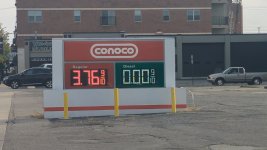
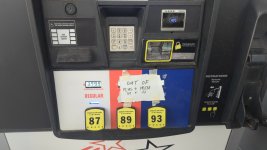
Southeast Indiana:
cameringo_20261001_173333.jpg
This station has had no diesel available for at least three days that we know of.


cameringo_20261002_172922.jpg
This station has been having problems keeping gasoline on hand for the past four weeks. Usually, it's just the higher grades, but there have been a couple of times they have been completely out.

Also, our local farmers have been harvesting crops weeks earlier than normal this year. We're assuming because they are concerned about diesel shortages.
 
You mean record profits by oil companies in 2026? I agree.
It’s absolutely true.
So we have two options price or profit caps.
Any one remember the impact of price caps on fuel prices in the 70’s,
Lines and shortages. That worked so well even the kind hearted Carter repealed them near the end of his term.

Or expand refining capacity and capacity in general.

It is the limitations on the world market that are currently driving competition for refined fuel. With competition come increased retail prices.
This increased competition for resources = price increases is basic economics. Supply and demand, it’s older than western capitalism.

From my prospective we worry about the SPR. We also should also worry about refining capacity. Because there is a direct economic principal linking limited capacity and availability to increased prices. What we should do is limit regulation and regulation expense. While at the same time treat oil companies capacity to produce just like the SPR.
Make it part of the national security umbrella. If your going to be in the oil business we will reduce regulatory demands and you will maintain the ability to produce what the nation would need in times of crisis or

Unless we want to tell companies you can only make so much on the product you produce and sell. Artificially capping profits does little to improve the situation. It basically discourages companies and investors from building those businesses.
 
It’s absolutely true.
So we have two options price or profit caps.
Any one remember the impact of price caps on fuel prices in the 70’s,
Lines and shortages. That worked so well even the kind hearted Carter repealed them near the end of his term.

Or expand refining capacity and capacity in general.

It is the limitations on the world market that are currently driving competition for refined fuel. With competition come increased retail prices.
This increased competition for resources = price increases is basic economics. Supply and demand, it’s older than western capitalism.
Ummm, no. The limitations causing the current crisis are due to reductions in oil shipping due to the Iran War. There was no fuel crisis before that little temper tantrum started interfering with shipments through the Strait of Hormuz.

From my prospective we worry about the SPR. We also should also worry about refining capacity. Because there is a direct economic principal linking limited capacity and availability to increased prices. What we should do is limit regulation and regulation expense. While at the same time treat oil companies capacity to produce just like the SPR.
Make it part of the national security umbrella. If your going to be in the oil business we will reduce regulatory demands and you will maintain the ability to produce what the nation would need in times of crisis or

Unless we want to tell companies you can only make so much on the product you produce and sell. Artificially capping profits does little to improve the situation. It basically discourages companies and investors from building those businesses.
Our refining capacity is just fine. The problem isn't capacity; the problem is we built all of our refineries to process heavy sour crude oil - which is all imported - versus the light sweet crude oil that comes from North America. That makes us dependent on foreign oil, which is a major national security oversight that should have been dealt with back in '79.

Apparently our dinosaurs ate healthier than Middle East dinosaurs.
 
Ummm, no. The limitations causing the current crisis are due to reductions in oil shipping due to the Iran War. There was no fuel crisis before that little temper tantrum started interfering with shipments through the Strait of Hormuz.
I believe I pointed out the diesel shortage were and are do to refined product, not crude alone. The withdrawal of Russian diesel and limited ME refining due to the bombings.

Our refining capacity is just fine. The problem isn't capacity; the problem is we built all of our refineries to process heavy sour crude oil - which is all imported - versus the light sweet crude oil that comes from North America. That makes us dependent on foreign oil, which is a major national security oversight that should have been dealt with back in '79.

Apparently our dinosaurs ate healthier than Middle East dinosaurs.

Out refining capacity is currently at 96% which for all practical purposes is at its limit. capacity is limited in that refining can only run at design specs for different produces because how much of one type of fuel you produce impacts how much of another you can produce.
The closer your refineries are at capacity the more limited the refinery are in altering their production output.

This is a world market and our diesel is in competition with world shortages.

Russia and Middle East reductions are 5% of global refined diesel supply. The global impact on the price and availability of diesel is significantly higher.


I am not denying the conflict with Iran hasn’t influenced it, it absolutely has. But there are other impacts in any global resource availability and price.

There was no crude oil shortage during Covid, there was actually an Oil supply glut. Yet the prices spiked then comparable to what we have seen this year to due to reduced demand.

Your also right we built our gulf coast refineries in the seventies to utilize the largest oil reserves in the world, Venezuela. Right here in our hemisphere.
We had the contracts, built the fields and developed the infrastructure. Remember this was the seventies before fracking had demonstrated our production capacity of sweet crude. So yes we did build many of our last major refineries to process sour crude. We didn’t exactly have proven domestic reserves to not seek out sour crude overseas. We were desperate at the time to limit our dependence on Gulf oil as I recall.

Since then we made building refineries cost prohibitive, then we let Venezuela slip to Russian and Chinese influence losing access to a resource our companies developed. That was real smart wasn’t it?

That mistake has been corrected.


I was only comparing our refinement capabilities and their limits to the strategic purposes similar to the purpose of the SPR.

We can grow our SPR beyond historic maximum, ban exports of US fuel. Banning US fuel exports very well might trigger a global economic implosion right now. So that’s not an option really. Or we can increase refinery capacity in order to respond to strategic crises. No quick fix here.
We of course also could have decided to not to deal with Iran now as well.

But markets and retail price as it fluctuates is never just about one causative factor. This is even more true when it’s applied to energy resources internationally.

 
Back
Top Bottom