• Guests may view all public nodes. However, you must be registered to post.

Trump Trade War U.S.-China agree to cut tariffs - Dow futures rocket higher by 1,100 points


Investing.com -- In recent trade negotiations with the US, India has proposed zero tariffs on specific imports such as steel, auto components, and pharmaceuticals, up to a certain quantity, according to a report from Bloomberg, citing sources close to the matter. The regular level of duties would be applied to imported industrial goods beyond this threshold.
Skip to content

 
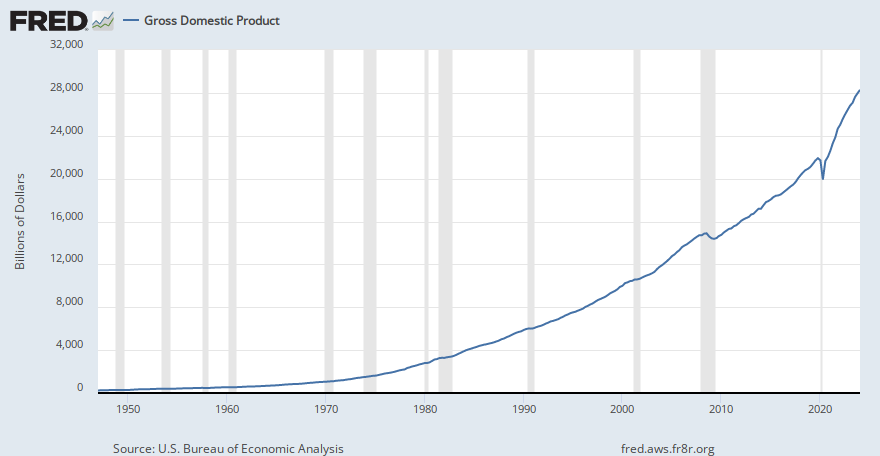
In about the same time frame, the US lost about $81 billion off our GDP for the first quarter of 2025. The last quarter of 2024 we gained about 540 billion of GDP
 
By... **Checks notes** 0.9% of the federal deficit. Maybe 10% of the deficit over a years span, MAYBE. With the consequence of nearly crashing the economy before backing down because they nearly crashed the economy. Which would lower gdp. Making a higher debt to gdp ratio.
The economy did not almost collapse. Fear mongers fanned the flames of despair and like all stock market fluctuations rebounded. It’s back to where it was in Oct of 2024.
 
In about the same time frame, the US lost about $81 billion off our GDP for the first quarter of 2025. The last quarter of 2024 we gained about 540 billion of GDP
Seems to be the GDP is still tracking just fine
 
Seems to be the GDP is still tracking just fine

Its not. It contracted in Q1 2025.
 
The economy did not almost collapse. Fear mongers fanned the flames of despair and like all stock market fluctuations rebounded. It’s back to where it was in Oct of 2024.
It really did almost collapse, until tarrifs were rolled back, all economic indicators showed. Even now economic indicators suggest a recession may still happen despite tarrifs being rolled back, due to economic uncertainty.

Just because it isn't convenient to admit doesn't change how the tarrifs were and are threatening the economy, and blanket tarrifs have been shown to be bad for the economy again and again.

" The Party told you to reject the evidence of your eyes and ears. It was their final, most essential command."
 
It really did almost collapse
Maybe it would be helpful if you showed why you think the economy almost collapsed rather than just chanting it.

I do know the economy shrank during the last quarter. But that is too little data to be throwing around the word "collapsed".

Interest rates held, employment went up I think, and the Consumer Price Index actually dropped in March. Core inflation is expected to remain unchanged. This is all from United States Inflation Rate
 
Maybe it would be helpful if you showed why you think the economy almost collapsed rather than just chanting it.

I do know the economy shrank during the last quarter. But that is too little data to be throwing around the word "collapsed".

Interest rates held, employment went up I think, and the Consumer Price Index actually dropped in March. Core inflation is expected to remain unchanged. This is all from United States Inflation Rate
The bond market showed signs of serious strain and distrust in America, and the bond market is actually what determines rates, the fed does not. Obviously the stock market had a rapid drop, which while it wasn't that big historically, when businesses are concerned about their stock prices they tend to pause investments and pause job hirings, which slows the economy. People tend to pull riskier investments such as venture capitalism, which is how new businesses tend to start.

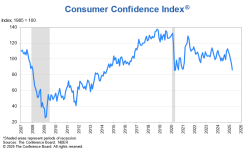
Consumer sentiment has also dropped and consumer sentiment pretty much entirely runs the economy, whether or not it's reasonable. When people decided they can't afford owning a house anymore, we had the great recession.

Recessions normally felt or show excessively in data a year or more after the economy starts showing signs of struggle, so we will see how current things pan out, but had tarrifs continued people would expect higher prices, businesses would expect lower demand and buy less goods, which can either increase prices or drop them depending how much consumer demand actually shows.

We have shown a dramatic drop in imports and freight amounts dramatically dropped. The world started to distrust us and foreign and domestic investors have chosen to diversify investments around the world.

I am on mobile so if you need I can get on my computer later to make it easier to provide

Core inflation will remain the same overall, that isn't where the risks to the economy comes from. It comes from how businesses and consumers react to tarrifs. Everyone has a shirt, few people need more shirts, so they don't even consider buying one while tarrifs are in effect. That eventually will reduce prices, but reducing prices in such a manner leads to less profit for these businesses which leads to less new hirings, less pay raises, less investment, more lay offs, which leads to less money in the average consumers pocket.

That fear Oreid talks about, doesn't matter how justified or how much we know. All economic crashes happen because people feel like the economy is doing bad, and they close their wallets. Tarrifs mean that price cuts have to be more extreme in order to balance supply and demand, which negates the 1 good thing that happens during recessions, and that is that prices drop on average.
 
and the bond market is actually what determines rates, the fed does not.
That is not true. Not at all.

The bond market can affect rates, but interest rates are controlled by overnight loan rates which are controlled by the Feds. All rates are based on that. If the feds lower rates, money becomes more available. If they raise rates, money becomes less available. Which bonds react to.

Consumer sentiment has also dropped and consumer sentiment pretty much entirely runs the economy, whether or not it's reasonable. When people decided they can't afford owning a house anymore, we had the great recession.
Yes, there was a pretty good drop in consumer sentiment.

It comes from how businesses and consumers react to tarrifs.
That is not true at all either. Tarrifs are a news item, a passing fancy. Consumers react to prices. If prices goes up, spending goes down. According to the CPI -- as I posted -- prices are relatively unaffected.

That could have changed in the coming months if the tariffs remained the same. Or the economy could have adapted.

"Nearly crashing the economy" is what you said and you have no data to back that up. Just a hope that it would have happened because you don't like "that guy".
 
That is not true. Not at all.

The bond market can affect rates, but interest rates are controlled by overnight loan rates which are controlled by the Feds. All rates are based on that. If the feds lower rates, money becomes more available. If they raise rates, money becomes less available. Which bonds react to.
Bond market determines what the government spends to borrow money, which affects the feds interest rates on the loans it gives banks in order to loan to you. Fed funds rate absolutely follows the bond market because the US government does NOT determine it's borrowing costs. The market does. They can be decoupled temporarily, but the government loses money when it's charging less interest than the cost of the money it is loaning to banks. The reason that the fed can lower interest rates in a recession is that businesses and banks invest more in bonds which means they will accept lower intrest rates. Our debt system is a very weird system. Bank borrows money from the federal reserve using assets as collateral, those assets are more heavily bonds in a recession. However, if international and business investors are weary of bonds, the banks are the only ones to get them, and they want a higher interest rate for a higher risk. They then get loans from the fed, which determines the interest rate they charge a perfect 900 credit score millionaire
Yes, there was a pretty good drop in consumer sentiment.

That is not true at all either. Tarrifs are a news item, a passing fancy. Consumers react to prices. If prices goes up, spending goes down.
Look up "deflationary spiral". Its by far the most common form of economic crisis.

According to the CPI -- as I posted -- prices are relatively unaffected.
News items start recessions. Every single business and consumer is looking towards the future when considering money they spend. If they fear lay offs or higher prices, they choose to save instead.

If consumers only reacted to prices neither the great recession nor the great depression would have started. Neither of those were caused by excessive prices. Both were caused by speculative investments that people realized just how risky they were, and pulled their investments, which crashes the economy. Investments and liquidity are essential to a functional business, so jobs were lost, wages were cut. If you managed to avoid wage cuts and kept your job during the great depression, you got richer relative to prices, as they were dropping. Prices dropping means businesses have less money. Stocks dropping means businesses can't get as large of loans. Demand dropping means those loans get a higher interest rate as banks aren't sure of the businesses solvency.

"Nearly crashing the economy" is what you said and you have no data to back that up.
I do, I can get you sources but you already wrote off all those factors that I can find data on, saying that prices are what effects the economy, when most economic disasters have a clear trend of deflation and reduced prices. Do you know how cheap things got during the great depression?

Just a hope that it would have happened because you don't like "that guy".
Ah yes, I clearly want the economy to crash just to spite Donald Trump! Very clearly. Nevermind that an economic collapse now would mean that I simply cannot get ahead in life, and that I will be too old to ever be able to retire by the time I can start making money, as if there's a flying chance that I will ever retire anyway. I'll already never own a home, probably will never own a reliable car, likely will never own a reliable phone (essential for the modern world, and that all is if the economy *doesn't* crash. If it does, best hope it recovers soon and I see benefits somehow from the deflation recessions bring. Or it could be a decade before the economy recovers and I'll be about a decade behind my parents in financial security, and my parents simply never became financially secure, they were close before the great recession caused us to lose our home move to a "cheap" area where it wasn't possible to escape poverty.

I would absolutely love if Trump really had the cure all for the economy, half my generation would bend over and kiss his ass if he somehow fixed the economy. But what he's doing won't fix it.

 
The bond market showed signs of serious strain and distrust in America, and the bond market is actually what determines rates, the fed does not. Obviously the stock market had a rapid drop, which while it wasn't that big historically, when businesses are concerned about their stock prices they tend to pause investments and pause job hirings, which slows the economy. People tend to pull riskier investments such as venture capitalism, which is how new businesses tend to start.

Consumer sentiment has also dropped and consumer sentiment pretty much entirely runs the economy, whether or not it's reasonable. When people decided they can't afford owning a house anymore, we had the great recession.

Recessions normally felt or show excessively in data a year or more after the economy starts showing signs of struggle, so we will see how current things pan out, but had tarrifs continued people would expect higher prices, businesses would expect lower demand and buy less goods, which can either increase prices or drop them depending how much consumer demand actually shows.

We have shown a dramatic drop in imports and freight amounts dramatically dropped. The world started to distrust us and foreign and domestic investors have chosen to diversify investments around the world.

I am on mobile so if you need I can get on my computer later to make it easier to provide

Core inflation will remain the same overall, that isn't where the risks to the economy comes from. It comes from how businesses and consumers react to tarrifs. Everyone has a shirt, few people need more shirts, so they don't even consider buying one while tarrifs are in effect. That eventually will reduce prices, but reducing prices in such a manner leads to less profit for these businesses which leads to less new hirings, less pay raises, less investment, more lay offs, which leads to less money in the average consumers pocket.

That fear Oreid talks about, doesn't matter how justified or how much we know. All economic crashes happen because people feel like the economy is doing bad, and they close their wallets. Tarrifs mean that price cuts have to be more extreme in order to balance supply and demand, which negates the 1 good thing that happens during recessions, and that is that prices drop on average.
And that is in the perception factor You approach this as an investor I assume. I approach this as a builder of economies your are ignoring or dismissing that if a nation does not have a stable core of durable goods manufacturing that nations economy will eventually implode. I fact you have minimized its importance repeatedly.

Yes we live in a global economy and I genuinely celebrate all of the potential good that this portends. However if this global economy exist where some nations can enact predatory import tariffs or impediments to imports while others seemingly cannot reciprocate when called for. Then it stopped being a genuinely free trade environment. This is not just bad for the nations who have import restrictions levied against them. It is not good for the nations who are capitalizing from their imposition of trade against wealthier nations.

Are we to boast about cheap goods from China with little concern for how Chinese laborers are treated. Or sing the praises rare earth mining or lithium mining and The environmental duty of going green. All the while ignoring the environment health cost it is levied against the land or workers in these countries.

Anyone who thought or believed Trump was going to impose 125% tariffs on China ad infintium or negotiate with India Japan or the EU in some nexus of unflinching toughness. Well I’m sorry you just were not paying attention or blinded by some vestigial fear of change of rocking the boat.

This brings us to what is wrong with measuring and gauging the economy based solely on short term stock performance or questionable consumer confidence. Which is an illusive beast oft quoted but seldom trustworthily report. It’s almost as illusive as a Bigfoot sighting.

Shall we go back to post covid which reflected the same levels as now? Or should we go back to 2009 or 2012 when surely the economy would certainly have already collapsed and we would still be locked in the throes of world wide depression.
Or should we revel in the lack luster sawback ups and down of Bidens post covid Consumer confidence.

Or just maybe we might look at another consumer confidence growth spurt with a different administration with tangible economic results.

IMG_0587.png
But I know he’s crazy and unhinged and has no track records.

After a little data this brings us back to perceptions and fears. The belief that Trump was going to engage in unflinching tariff negotiations, like some mob boss, with nations irregardless of realities or necessity was just hilarious.
Of course Trump has negotiated terms with nations that were not what was initially demanded. It’s business it’s a negotiation, it’s Trump and it’s worked in the past and to pontificate or run around pell mell claiming the sky is failing is fun to do but not reflective of reality.
 
People who have a life built by now do not grasp just how bad the economy is for gen z, just how hard it is to find a job that will pay enough to ever own a home, just how much money we have to spend to have reliable transportation to get to work.

Heres the thing. Not owning a house or car, I have a lot of spare money laying around I can do all sorts of fun things spend all sorts of money. I would need nearly triple my current wage to be able to afford a house and a car. And tarrifs increase car prices. Housing prices can either remain the same or they can drop and crash the economy like it's '08 again, then I don't have a job and can't afford anything. These tarrifs at best definitely aren't fixing housing and car prices, interest rates haven't dropped which makes houses even more absurdly expensive.

And I'm lucky I have a job, because my generation is widely a highly educated workforce that has too much student loan debt to accept unskilled work, and there just aren't enough STEM jobs for all the STEM grads. There aren't enough business jobs for the oversaturation of business degrees. There aren't enough computer jobs for the oversaturation of people with computer science degrees.

We don't want the factories back. We want higher paying jobs that match our skill sets, most of gen z isn't fit for factory jobs, they don't have the skills, they have different skills.

And then Trump says, well we are going to tax imports until you accept factory jobs that pay too little to afford a house and car and paying off student loans.
 
And that is in the perception factor You approach this as an investor I assume.
No I approach this as someone who has been educated in economic crisis, and also as someone who can see how the current economy is flawed for young people.

I approach this as a builder of economies your are ignoring or dismissing that if a nation does not have a stable core of durable goods manufacturing that nations economy will eventually implode. I fact you have minimized its importance repeatedly.
If that's the case, why are the most advanced economies service based? A core manufacturing base is necessary in an under skilled population and an environment where stable global trade is disrupted. But manufacturing jobs just don't pay enough for people to be able to buy the goods they produce.

Yes we live in a global economy and I genuinely celebrate all of the potential good that this portends. However if this global economy exist where some nations can enact predatory import tariffs or impediments to imports while others seemingly cannot reciprocate when called for. Then it stopped being a genuinely free trade environment. This is not just bad for the nations who have import restrictions levied against them. It is not good for the nations who are capitalizing from their imposition of trade against wealthier nations.

Are we to boast about cheap goods from China with little concern for how Chinese laborers are treated.
Look at how American laborers are treated now in their factories. Usually pretty poorly. Piss jugs in the Amazon warehouse.
Or sing the praises rare earth mining or lithium mining and The environmental duty of going green. All the while ignoring the environment health cost it is levied against the land or workers in these countries.

Anyone who thought or believed Trump was going to impose 125% tariffs on China ad infintium or negotiate with India Japan or the EU in some nexus of unflinching toughness. Well I’m sorry you just were not paying attention or blinded by some vestigial fear of change of rocking the boat.

This brings us to what is wrong with measuring and gauging the economy based solely on short term stock performance or questionable consumer confidence. Which is an illusive beast oft quoted but seldom trustworthily report. It’s almost as illusive as a Bigfoot sighting.

Shall we go back to post covid which reflected the same levels as now? Or should we go back to 2009 or 2012 when surely the economy would certainly have already collapsed and we would still be locked in the throes of world wide depression.
How did we avoid a depression then? We spent trillions of dollars and now the government says we won't do that.
Or should we revel in the lack luster sawback ups and down of Bidens post covid Consumer confidence.
Biden never instilled economic hope because he wasn't fixing the actual problems, which are wages, house prices, and car prices.
Or just maybe we might look at another consumer confidence growth spurt with a different administration with tangible economic results.

View attachment 7345
But I know he’s crazy and unhinged and has no track records.
The economy was steadily improving prior to COVID globally, yes. You can attribute it to Trump, I personally was too busy stealing just to survive during Trump's first term. So I'm not sure how good the economy was. Didn't seem too good for me.
After a little data this brings us back to perceptions and fears. The belief that Trump was going to engage in unflinching tariff negotiations, like some mob boss, with nations irregardless of realities or necessity was just hilarious.
Trump has been touting tarrifs as a way to pay for his tax cuts on the rich. And there still are 10% tarrifs across the board. He is obsessed with them. He only started negotiating because everyone told him the economy was about to blow up.

Of course Trump has negotiated terms with nations that were not what was initially demanded. It’s business it’s a negotiation, it’s Trump and it’s worked in the past and to pontificate or run around pell mell claiming the sky is failing is fun to do but not reflective of reality.

You know I was here for Trump's first term? Remember it quite clearly. The economy mostly remained stable and that bred confidence but the problems still existed, they got amplified after COVID, and that amplification started before Trump left office.
 
Bond market determines what the government spends to borrow money, which affects the feds interest rates on the loans it gives banks in order to loan to you. Fed funds rate absolutely follows the bond market because the US government does NOT determine it's borrowing costs. The market does. They can be decoupled temporarily, but the government loses money when it's charging less interest than the cost of the money it is loaning to banks. The reason that the fed can lower interest rates in a recession is that businesses and banks invest more in bonds which means they will accept lower intrest rates. Our debt system is a very weird system. Bank borrows money from the federal reserve using assets as collateral, those assets are more heavily bonds in a recession. However, if international and business investors are weary of bonds, the banks are the only ones to get them, and they want a higher interest rate for a higher risk. They then get loans from the fed, which determines the interest rate they charge a perfect 900 credit score millionaire
Funny everything I read the bond market is what does the reacting to the fed rates.
Look up "deflationary spiral". It’s by far the most common form of economic crisis.


News items start recessions. Every single business and consumer is looking towards the future when considering money they spend. If they fear lay offs or higher prices, they choose to save instead.

News items alone do not start recessions, persistent real world events and economic factors start recessions.
News items can start panic selling which soon turns into embarrassing investing choices
If consumers only reacted to prices neither the great recession nor the great depression would have started. Neither of those were caused by excessive prices. Both were caused by speculative investments that people realized just how risky they were, and pulled their investments, which crashes the economy.
The depression started because when the panic started there was nothing there to support the panic. That was not a news item alone it was an actual reality of a significantly over inflated market ( real world be vs short term panic)
Investments and liquidity are essential to a functional business, so jobs were lost, wages were cut. If you managed to avoid wage cuts and kept your job during the great depression, you got richer relative to prices, as they were dropping. Prices dropping means businesses have less money. Stocks dropping means businesses can't get as large of loans. Demand dropping means those loans get a higher interest rate as banks aren't sure of the businesses solvency.


I do, I can get you sources but you already wrote off all those factors that I can find data on, saying that prices are what effects the economy, when most economic disasters have a clear trend of deflation and reduced prices. Do you know how cheap things got during the great depression?


Ah yes, I clearly want the economy to crash just to spite Donald Trump! Very clearly. Nevermind that an economic collapse now would mean that I simply cannot get ahead in life, and that I will be too old to ever be able to retire by the time I can start making money, as if there's a flying chance that I will ever retire anyway. I'll already never own a home, probably will never own a reliable car, likely will never own a reliable phone (essential for the modern world, and that all is if the economy *doesn't* crash. If it does, best hope it recovers soon and I see benefits somehow from the deflation recessions bring. Or it could be a decade before the economy recovers and I'll be about a decade behind my parents in financial security, and my parents simply never became financially secure, they were close before the great recession caused us to lose our home move to a "cheap" area where it wasn't possible to escape poverty.
I’m sorry this is just emotional drivel
I would absolutely love if Trump really had the cure all for the economy, half my generation would bend over and kiss his ass if he somehow fixed the economy. But what he's doing won't fix
 
And that is in the perception factor You approach this as an investor I assume.
You always are assuming when I criticize Trump that means I love Democrats and love their policies and the economy was just fantastic and everyone was partying daily with all their spare money. They weren't.

My argument is that Trump is trying to make our economy a more primitive one by alienating US globally, when the cost of our goods are because of how reliable of a trade partner we are. Because my whole life, products have been dirt cheap. Food pretty dirt cheap but it got more expensive. Its housing and car prices, and student loan debt, it isn't that I couldn't go work at some factory in some random places. Its that a factory wouldn't pay me enough to own the damn transportation required to get there, and my body would be ruined, but I couldn't retire because I don't have a paid off house.

Cars won't be cheaper if manufactured here, wages for making those cars wouldn't get higher because if they did, the cars would get more expensive. Houses won't get cheaper because every time they do landlords buy them up and raise rent. So how is taxing my shirt going to make me rich?
 
Back
Top Bottom