• Guests may view all public nodes. However, you must be registered to post.

Taiwan/Pacific Tensions | US-Japan-Australia / China-Russia

  • Thread starter Thread starter NuclearID
  • Start date Start date
If the PRC starts intercepting ships into or out of TWN it creates quite a grey zone dilemma.

I am still of the opinion the PRC does not have the resources to be successful with a TWN invasion either this year or next.
I agree with you on that. They may become pragmatic and accept that the economic cost is not worth it but time may provide opportunities.
 

China and Russia to hold annual joint naval drills​

Exercises from Monday to July 13 off Qingdao to be followed by joint maritime patrols in the Pacific Ocean

The Chinese and Russian navies will hold joint exercises in the waters and airspace off China’s eastern coast this coming week.

The manoeuvres come roughly two months after Russian President Vladimir Putin’s trip to China, during which he described bilateral relations as having reached an “unprecedentedly high level”.
 
🇦🇺🇯🇵🇺🇸✈️
Australia, Japan and the United States launched Exercise Southern Cross 26, with more than 1,000 personnel and up to 40 aircraft deployed to RAAF Bases Darwin and Tindal from July 6th to 17th.

Australia says the exercise focuses on high end trilateral warfighting, dispersed operations, multinational aircraft maintenance, air to air refueling and live inert weapons employment.

🔗⤵️
 
🇷🇺🇨🇳⚓🌊
UPDATE: Russia’s Ministry of Defence says a Pacific Fleet detachment arrived in Qingdao for the Russian & Chinese Maritime Interaction, Joint Sea 2026 exercise.

The exercise is scheduled in the Yellow Sea from July 6th to 13th, following earlier Chinese confirmation of a planned joint Pacific patrol by some forces from both sides.

🔗⤵️
 
🇨🇳☢️🚢
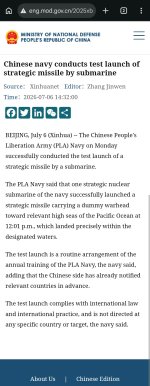
The PLA Navy said a strategic nuclear submarine launched one submarine launched strategic missile carrying a dummy warhead toward relevant high seas of the Pacific Ocean at 12:01 p.m. on July 6th, landing within the designated waters.

🔗⤵️

☝️
It is a Chinese government website and is typically flagged by all Western service providers. Simply most will have trouble gaining access to website as ISP provider may or most likely has blocked it. ALSO, if you are in the military or work for the government you should not access this site on your personal or work devices WHATSOEVER.

Here is a screenshot of the Chinese government publication in the event most of you are unable to access website:
1757.jpg

@DEFCON Warning System @RiffRaff @Irag8er @Torch @Sentry
 
🇨🇳☢️🚢
The PLA Navy said a strategic nuclear submarine launched one submarine launched strategic missile carrying a dummy warhead toward relevant high seas of the Pacific Ocean at 12:01 p.m. on July 6th, landing within the designated waters.

🔗⤵️

☝️
It is a Chinese government website and is typically flagged by all Western service providers. Simply most will have trouble gaining access to website as ISP provider may or most likely has blocked it. ALSO, if you are in the military or work for the government you should not access this site on your personal or work devices WHATSOEVER.

Here is a screenshot of the Chinese government publication in the event most of you are unable to access website:
View attachment 9205

@DEFCON Warning System @RiffRaff @Irag8er @Torch @Sentry
 
American commandos are operating openly inside Taiwan’s elite military bases,
US military personnel have been repeatedly spotted entering and exiting Wuhan Camp, the strategic headquarters of Taiwan’s Army Special Warfare Command in Taoyuan, according to local observers and major Taiwanese media outlets.
This public exposure highlights a rapidly deepening tactical alliance, with US Congress estimating that around 500 American military trainers are currently embedded across the island. Amid escalating Chinese naval blockades and airspace violations, Washington is already moving forward with plans to double that deployment to 1,000 elite personnel, directly embedding US Special Forces into Taiwan’s core defense infrastructure to prepare for asymmetric guerrilla warfare.This isn't just routine military training; it is a clear, deliberate message that the US military is already on the ground and ready to fight for Taiwan. By putting American boots inside Taiwan's most elite special forces hubs, Washington is completely shattering Beijing's illusions of a swift, unopposed invasion, proving that any Chinese assault on the island will mean a direct, catastrophic kinetic clash with the United States.

 
At a time when the United States is working harder than ever to prevent nuclear proliferation, China is doing the opposite. Beijing’s rapid and opaque nuclear weapons buildup is of great concern to the region and the world. We continue to urge China to engage in meaningful arms control discussions and commit to a regularized notification arrangement for all intercontinental-range ballistic missile and space launches consistent with commitments made by all other P5 members. The United States remains steadfast in our defense commitments to our allies and partners.”

‘Don’t threaten us’: Albanese, Solomons PM condemn ‘provocative’ China missile launch​

Prime Minister Anthony Albanese and one of the Pacific’s key leaders have united to condemn China’s intercontinental ballistic missile launch, labelling it a provocative, threatening and unfriendly act undertaken without sufficient notice. It is standard procedure for tests such as this, for there to be given 48 hours notice,” Albanese said.

“This was not done on this occasion.”
Pacific Minister Pat Conroy rejected Beijing’s claim that the test complied with international law and practice, saying: “It’s not consistent with The Hague convention on ballistic missile testing, which would require more notice and greater information provided to countries.

“We would continue to call on China to abide by The Hague convention.”
Acting prime minister Richard Marles said Australia was warned about the test just two hours before launch.
NATO Secretary General Mark Rutte said the test-firing by China of a missile from a nuclear-powered submarine into the Pacific sent a message to the alliance.

“This, again, is evidence that we cannot be naive,” Rutte told reporters on the eve of a NATO leaders’ summit in Ankara. “And we are not.” Opposition defense spokesman James Paterson told ABC radio: “I share the concerns that Pat Conroy just aired on your program, that it is not consistent with best practice, that there was very minimal notice given of just a couple of hours and very little details given about where it would be fired from and where it would be fired to.”

​

https://www.smh.com.au/world/asia/b...an-unmistakeable-warning-20260706-p60d1l.html
 
And before the "Hate America Club" chimes in! 👇

U.S. Notification of ICBM Launches​

The United States does notify other countries — including Russia — in advance when it launches an ICBM, but the timing and method depend on the type of launch and applicable agreements.

1. Bilateral treaty obligations
Under the Ballistic Missile Launch Notification Agreement (1988), signed between the U.S. and the Soviet Union (now Russia), each side must notify the other at least 24 hours in advance of the planned date, launch area, and area of impact for any launch of an ICBM or submarine‑launched ballistic missile (SLBM) atomicarchive.comatomicarchive.com+1. These notifications are transmitted through the Nuclear Risk Reduction Centers.

2. Routine test launches
For operational or test ICBM launches, the U.S. follows standard procedures. For example, in 2024, an unarmed Minuteman III test launch from Vandenberg Space Force Base was scheduled years in advance and notified the Russian government in advance in accordance with both the Hague Code of Conduct and existing bilateral obligations Air Force Global Strike CommandAir Force Global Strike Command.

3. De‑alert posture and security
The U.S. maintains its nuclear forces in a posture that minimizes the risk of accidental or unauthorized launch. While some missiles are on “alert” day‑to‑day, they are targeted on open ocean areas so that an accidental launch would not hit another nation 2009-2017.state.gov2009-2017.state.gov. Launch authorization requires an authenticated, encrypted order from the President, not a routine notification.

4. When notification is not required
The treaty and related agreements apply to planned strategic ballistic missile launches. They do not cover all possible scenarios, such as unplanned or accidental launches, which are handled under different security and crisis protocols.

In summary:
Yes — the U.S. does notify other countries when it launches an ICBM, especially for planned strategic launches, under the 1988 Ballistic Missile Launch Notification Agreement. The notice is typically given at least 24 hours in advance and includes launch details. This is part of confidence‑building measures to reduce the risk of misinterpretation or escalation
 
🇨🇳🌊🚀
UPDATE: Pacific leaders criticized China’s nuclear capable submarine launched missile test, after the missile reportedly flew over multiple Pacific island EEZs and landed near the EEZs of Tuvalu and Kiribati.

Australia said concerns were raised in both Beijing and Canberra, while Pacific leaders warned against using regional waters for weapons testing.

🔗⤵️
 
Open-source PLA military writings and observations suggest Chinese views of U.S. stealth have been shaped by a mix of empirical observation, cognitive biases, and technological ambitions ... [T]hese perceptions are often incomplete or skewed, leading to an overreliance on hardware solutions, an underestimation of U.S. operational adaptability, and a framing of stealth as a technical rather than an operational problem."
 
Deep dive into the latest unclassified data on China’s nuclear forces. Beijing is systematically cementing a modern nuclear triad, moving far beyond its historical minimal deterrence model. Here is what the latest open-source data tells us:
Land-based forces still form the core. China has completed its massive solid-fuel ICBM silo expansion project across three distinct fields (Yumen, Hami, and Yulin). Over 300 new silos are online, introducing a strategic "shell game" to complicate adversary targeting. 2/
The big crisis flashpoint? The intermediate-range DF-26 missile. It is heavily deployed, with new infrastructure operational at the 647 Brigade in Zhangye. It features a "fast-switch" capability between conventional and nuclear warheads. 3/
This dual-capability creates acute danger. In a high-stakes regional conflict, launching a conventional DF-26 against a base could easily be misread by an adversary as a nuclear first strike, triggering catastrophic, mistaken preemption or retaliation. 4/
At sea, China's 6 Jin-class (Type 094) SSBNs are running "near-continuous" patrols. A full fleet accounting occurred on March 8, 2026, via satellite: 4 docked at Longpo Base (Hainan) and 2 undergoing fitments at the Huludao shipyard. 5/
The sea leg is gaining reach. Type 094 subs are rotationally swap-fitting JL-2 legacy missiles for the 10,000-km range JL-3 SLBM. Operating out of northern maritime sanctuaries like the Bohai Sea, they can now target the northwestern continental US. 6/
Next-gen subs are coming. Construction halls at Huludao are preparing for the larger Type 096 SSBN. Notably, US naval research indicates Russia is actively providing technical assistance to China to achieve much-needed propulsion silencing. 7/
The air leg has evolved. Legacy nuclear gravity bombs are entirely retired. The mission now rests on the modified H-6N bomber, which carries the newly unveiled JingLei-1 (JL-1) nuclear air-launched ballistic missile (US designation: CH-AS-X-13). 8/
Hiding in plain sight: The nuclear-tasked 106th Bomber Brigade at Neixiang Air Base has been extensively modified. Massive, hardened tunnel entrances cut directly into nearby mountains allow the H-6N fleet to roll straight underground out of satellite view. 9/
While China's air and sea legs are still technically less mature than those of the US or Russia, the operational triad is fully viable. The real immediate risk is theater ambiguity—where conventional moves could accidentally trip a nuclear fuse. 10/1
 
Back
Top Bottom