• Guests may view all public nodes. However, you must be registered to post.

Aircraft Carriers Will Be Defeated By Chinese Missiles

DEFCON Warning System

Director
Staff member
Joined
Aug 11, 2010
WEBSITE
http://www.defconwarningsystem.com
FACEBOOK
defconwarningsystem
TWITTER
DEFCONWSALERTS
YOUTUBE
DefconWarningSystem
Washington Post reporter @JoshRogin tells @GlennBeck that the Pentagon's leaked documents reveal China's hypersonic glide missiles defeat our aircraft carriers and missile defense systems: "We spent thirty years building aircraft carriers and missile defense, and the Chinese built a missile for 1/100000 of the price that makes those things obsolete... It flies faster than sound... and they can maneuver it to hit our aircraft carriers as far as Guam. Half the Pacific is now no entry for our aircraft carriers if they decide to use these things."

Gee, how long have I been saying that exact same thing?
 
And so they go the way of the Battleship.
No, there still needed to assert force across the world like Africa, Middle East, and in deep open waters far far far from land to protect shipping routes.

Aircraft carriers are obsolete against a regional power like China or Russia. But everyone else it is still very effective against.
 
  • Love
Reactions: Torch

Gee, how long have I been saying that exact same thing?
I've screamed up and down these forums for awhile now that the US will not use aircraft carriers against China.

There is no need when we have A LOT of military bases all around China. Not to mention the 4 new mega US bases being built in the Philippines to add to the EXTENSIVE list of US bases all around China.

Really zero need to use aircraft carriers against China.
 
I've screamed up and down these forums for awhile now that the US will not use aircraft carriers against China.

There is no need when we have A LOT of military bases all around China. Not to mention the 4 new mega US bases being built in the Philippines to add to the EXTENSIVE list of US bases all around China.

Really zero need to use aircraft carriers against China. We already have many assets and bases around them no need to risk aircraft carriers at all.
US aircraft from carriers will be needed to sink China’s fleet in detail and hunt down and turn Chinese subs into deep dive platforms or artificial reefs.
That said I think these super carriers are to heavy of an investment and much smaller carries (like the Marine corp) would be ideal. Less to lose at once, capable of spreading out, cheaper (by far) and probably easier to defend.

A large carrier might stay back beyond the (Feba Flot? Readers choice) to provide Aircraft as well as host and provide higher levels of maintenance and repair for fleet aircraft.
Side note to US Navy: how ever many active defense suites these US Navy“targets” have, they need much more. Start with doubling and go up from there
 
Last edited:
US aircraft from carriers will be needed to sink China’s fleet in detail and hunt down and turn Chinese subs into deep dive platforms or artificial reefs.
Not really. We have the best mid air refueling capabilities. We can send aircraft from mainland US, Hawaii, Guam and do exactly that without having to land for fueling indefinitely or until they can safly land basically anywhere in the world.

We have every "means" around China, coupled with our very large and capable mid air refueling capabilities pretty much remove or make obsolete the aircraft carrier from a battle with a large regional power like China or Russia. Just no need to risk them given we have many other means at our disposal to deal with them.

Aircraft carriers (imo) will be only used to assert force in the open seas far from land to secure shipping routes from priracy or project force against smaller nations not as capable as China & Russia.
 
  • Love
Reactions: Torch
Not really. We have the best mid air refueling capabilities. We can send aircraft from mainland US, Hawaii, Guam and do exactly that without having to land for fueling indefinitely or until they can safly land basically anywhere in the world.

We have every "means" around China, coupled with our very large and capable mid air refueling capabilities pretty much remove or make obsolete the aircraft carrier from a battle with a large regional power like China or Russia. Just no need to risk them given we have many other means at our disposal to deal with China.

Aircraft carriers (imo) will be only used to assert force in the open seas far from land to secure shipping routes from priracy or project force against smaller nations not as capable as China & Russia.
We absolutely DO NOT have the available numbers of refueling aircraft in order to refuel two sometimes three refueling per sortie whilst hunting down the Chinese subs over the entire Pacific and Indian oceans. We need mobile jet fuel stations. I believe that many are vastly underestimating just how good China Submarine Service is.
Also underestimated IMO is the J-20. These aircraft are going to be a challenge to manage and then kill as well.
 
Last edited:
Aircraft carriers (imo) will be only used to assert force in the open seas far from land to secure shipping routes from priracy or project force against smaller nations not as capable as China & Russia
Outstanding!!! 👍🏻👍🏻

My earlier post was about “ “Harrier Carriers” either Marine Assault or even improvised.

During the Falkland Campaign the British used Cargo containers stacked on the flat deck as walls and wind and sea barriers. Appears to have worked well enough.
 
Last edited:
The US Navy released footage last week of SM-2 missiles destroying a supersonic sea-skimming target, your view is from the attacking ship and missile.

Opinions
Tough shot but the Navy was 2 for 2! High fives all around. Ok will it stop 20 missile? How about 20 missiles and 02 hypersonic missiles? Without energy weapons, we are screwed.

 
Last edited:
From 2021

The tale of the KC-46 is a long and sad one. The Pentagon hadn’t bought a new tanker in a generation when, in the early 2000s, it pitted Northrop Grumman against Boeing for a potentially $40-billion deal to build 179 new refuelers.

Northrop’s Airbus-based KC-45 won the competition. But Boeing protested. The Pentagon re-ran the contest. This time Boeing, far and away the favorite of American politicians, won with its 767-based KC-46. In 2011, the Air Force cut a contract with the Chicago plane-maker for 179 of the new tankers.

The KC-46 was a mess from the start. The planes rolled out of Boeing’s Washington State factory with structural flaws and loose parts rolling around inside their structures. Worse, Boeing had designed a new remote video system that allowed the operator of the tanker’s refueling boom to sit in the cockpit instead of lying down in the plane’s tail.

The remote vision system produced video of such poor quality that operators couldn’t reliably steer their booms into the receptacles of receiving planes. The Air Force billed Boeing for the mistakes and, in 2019, temporarily halted deliveries.

Today Boeing has delivered around 50 of the tankers. They represent a tenth of the Air Force’s refueling fleet alongside nearly 400 KC-135s and 50 or so KC-10s, but possess almost no actual, you know, utility. The Air Force still bars the type from entering active combat zones.
 
From 2022

The Air Force is facing a gap in aerial refueling capacity through the mid-2020s as it retires aged KC-10 and KC-135 tankers faster than they can be replaced by the troubled KC-46A Pegasus or a follow-on tanker aimed at serving as a bridge between existing and next-generation capabilities.

A Hudson Institute report released in November, “Resilient Aerial Refueling: Safeguarding the U.S. Military’s Global Reach,” estimates the service will experience an approximately 6 to 11 percent reduction in aggregate fuel offload capacity this decade.

Already years behind schedule, the KC-46 will not be certified for full operations or cleared for full-rate production until 2024 or later due to ongoing deficiencies including problems with its remote vision system. However, AMC has approved four “interim capability releases” since last July.

The releases allow KC-46s to refuel approximately 70 percent of all aircraft supported during Transportation Command taskings, according to Air Mobility Command. The remaining 30 percent, including fifth-generation fighters like the F-22 and F-35 and bombers like the B-1B and B-2, have not been certified for refueling by the Pegasus due to clarity and depth perception issues related to its vision systems. A “stiff boom” problem rules out refueling the A-10 and other smaller aircraft.

In a conflict scenario in the South China Sea or in Europe, for example, KC-46s could not be employed for aerial refueling. AMC says “a lack of confidence” in its new tanker and the threshold for an “acceptable level of risk in the current world environment” preclude the KC-46 from deploying to support combatant command operations.

“The air refueling fleet remains one of the most stressed mission areas for USTRANSCOM.”

 
I think the question of how effective the CSG’s will be against China is up in the air. I agree it is a dicey and risky proposition for them to be used close in against China. But a strike group on the eastern sides of Japan and Guam can help provide significant air cap protection. This is all theoretical I believe anyway.
Until something pops off no one can say for certainty the importance the carriers will play in an offensive roll.

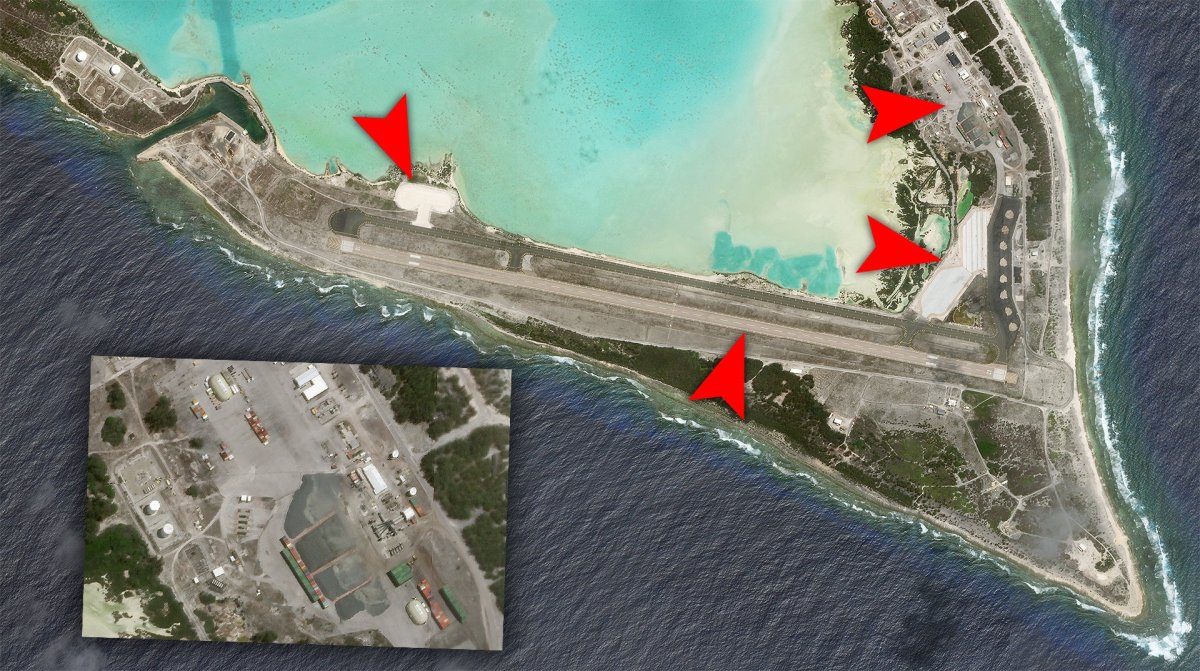
Remember the logistics, the DOD is retrofitting and up grading Wake island of all places because of its remote stop over and resupply.

Resupply to the west pac fleet of fuel and missiles will be critical in a shooting match.
The carriers will be important for mid ocean standoff to contain either Russian or Chinese ships.

Look at the air and ocean transport routes through the SCS to Japan. It’s a damn superhighway of tonnage.

No one has yet fought a war with the interconnected international trade as it is today. In any type of large conventional conflict at sea the carriers groups will be important to protecting shipping as it diverts east away from the coast or upon approaching Japan or ROK.
These are all huge unknowns no group of nations has ever faced before.

If this projection of power out away from the continent was not critical China would not be so determined to build islands or seize islands away from their coast. An airfield or port on Guam or the Philippines is honestly an easier target with a supersonic missile than a carrier 5 or 600 miles off the coast.

I’m not predicting with certainty how it would all turnout. Only pointing out that the CSG will be important for more than just launching strikes against Chinas coast or providing fighter cover over Taiwan.

The first order of business is close ALL the sea and air lanes in and out of China. You know just like a real war. Not some pseudo war.
But I’m not sure there are balls big enough in Washington to make that call.

One thing is for sure the likelihood of China actually trying something will only increase in the near term. I say that because they see us moving back into the Philippines and Japan. As well as Japan Building up their own military.
And armaments flowing to Taiwan. There will be a point in the near term where it will become too costly for China to risk attempting it.
Sooooo
Move fast - slam this door shut on China for another 40 years.

 
  • Love
Reactions: Torch
You can station Carriers at a distance from mainline China as one would deem safe.
However, these alliances that China is making in So. America, Central America, and Africa tells me
that these middles aren't going to just be deployed in China proper.
 
Back
Top Bottom