• Guests may view all public nodes. However, you must be registered to post.

General Debate on Religion-(CLOSED)

  • Thread starter Thread starter DucknCover
  • Start date Start date
Status
Not open for further replies.
Nah, not really. There are some extant writings which may have been authored by people who may have known Jesus, but it's a very small reference pool, with an uncertain provenance, and it certainly doesn't include any of the Gospels. Nor does it, in fact, tell us much about the life of Jesus.
This is untrue. Matthew and John walked with Jesus.

Also, referring to such writings as "documentation" is simply misleading.
That's a bit pedantic use of the word.

The simple fact is we have books written by Matthew, John, Peter, and James, all who knew Jesus personally.

If someone doesn't accept what they wrote about Jesus, that is on them. But it's akin to rejecting a biographer's work.
 
This is untrue. Matthew and John walked with Jesus.
Perhaps, but neither wrote any gospel. The texts commonly referred to as the Gospels of Matthew and John are believed to have been written sometime between AD 85 and 110 (based on decades of oral tradition), and continued to be modified well into the 3rd century. Neither text identifies its author; the ecclesiastical attribution is entirely spurious. What is more, both were written in fairly sophisticated Greek (specifically, a semitic variant thereof, known as "synagogue Greek"). Claiming that 1st century Galilean fishermen spoke Greek - the language of educated elites - is a major stretch; in fact, most of them were illiterate...

You can believe otherwise, but contradicting scientific consensus without presenting any evidence is the definition of religious faith.
 
Last edited:
Perhaps, but neither wrote any gospel. The texts commonly referred to as the Gospels of Matthew and John are believed to have been written sometime between AD 85 and 110 (based on decades of oral tradition), and continued to be modified well into the 3rd century. Neither text identifies its author; the ecclesiastical attribution is entirely spurious. What is more, both were written in fairly sophisticated Greek (specifically, a semitic variant thereof, known as "synagogue Greek"). Claiming that 1st century Galilean fishermen spoke Greek - the language of educated elites - is a major stretch; in fact, most of them were illiterate...

You can believe otherwise, but contradicting scientific consensus without presenting any evidence is the definition of religious faith.

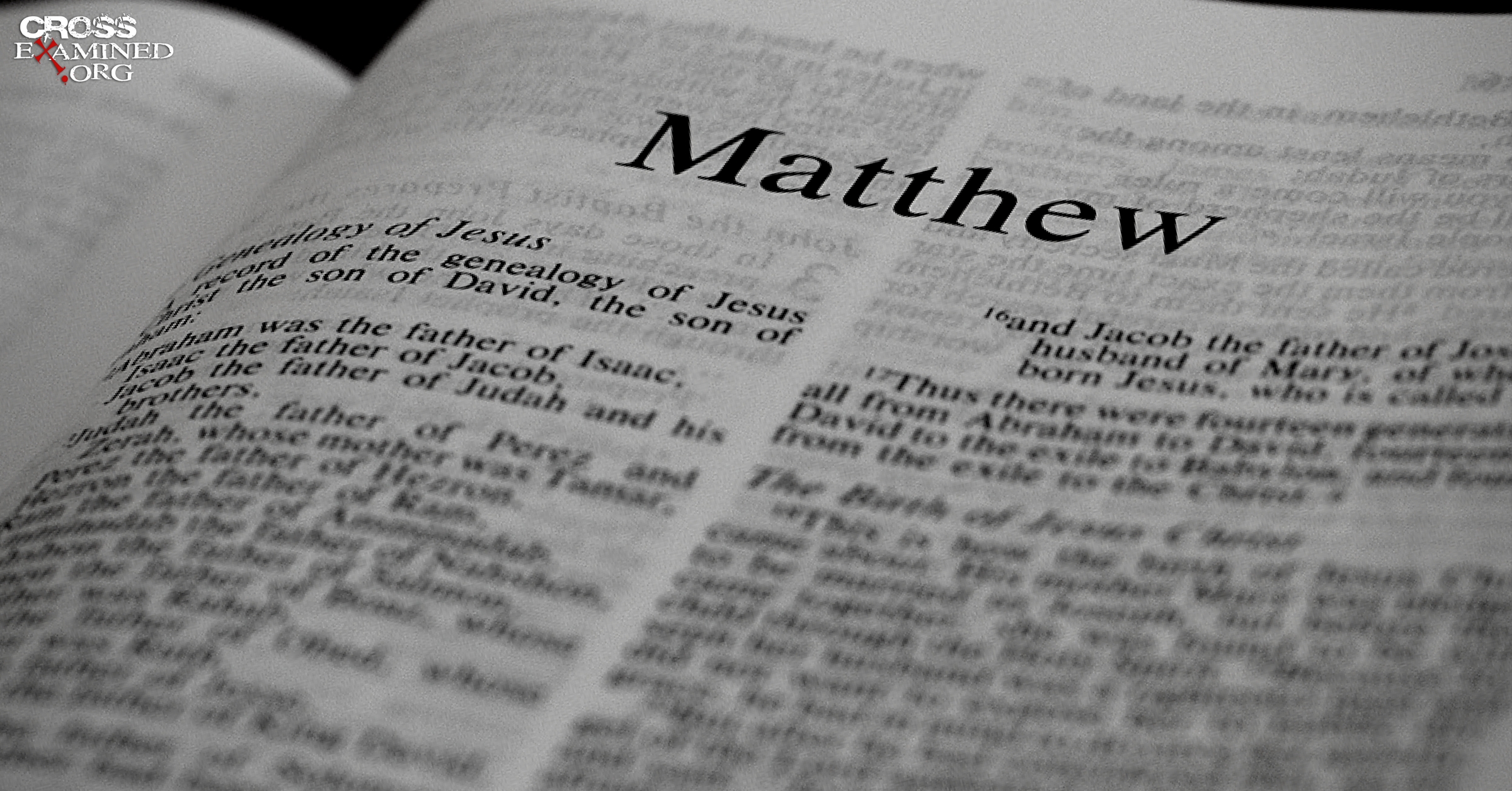
Who Wrote the Gospel of Matthew?​

Over the course of the new few weeks, we will discuss the reasons for accepting the traditional viewpoints for New Testament authorship. We will begin with the Gospel of Matthew today and will then move towards the other three Gospels before looking at some of the letters in Revelation.

The New Testament begins with the Gospel of Matthew. But, what do we know about the origin of the First Gospel? In a world where traditional scholarship is often questioned and too often disregarded, several theories exist as to whom the author of the First Gospel may be. Traditionally, the church has ascribed the First Gospel to the apostle known as Matthew. But, what evidence do we find about the author of the first book in the New Testament?


Matthew was not a fisherman. He was a tax collector. Luke was a doctor. Paul was an educated Pharisee. All educated men.
 
I don't want classroom-led prayer in school. I think it is something that can be abused.

However, if some students want to get together and form a group for prayer, there is nothing wrong with that.
Back in my school we had a group like this and they became radical praying for the gay people to get straight, and they'd break/go into the Gay/Straight club and well..crash it or protest it the whole time.


to be 100% honest I kind of got raped into doing the christian club thing. I walked past the room one day and they kept asking why couldn't I make time for god when I had a busy day that day..ended up losing like 2 hours, and they forced free pizza onto me, but like...then they tried to get me to go to church with major pressure.
 
Back in my school we had a group like this and they became radical praying for the gay people to get straight, and they'd break/go into the Gay/Straight club and well..crash it or protest it the whole time.
Conversely, we have liberal groups break into religious/conservative clubs/meeting or protest them the whole time.

It's down to the evil heart of man, not God.
 

Who Wrote the Gospel of Matthew?​


Oh great, a religious portal pushing a religious agenda. No peer review, no H index, nothing of the sort. But fine; just because the source is dubious doesn't mean the logic has to be as well (though it so often is...) So I've read through the text you linked, and it essentially offers the following argument:
  • The author knew a lot about Jewish law,
  • The author focuses on Jesus' work in Galilee,
  • Some references to taxation are to be found in the text,
  • So, therefore, the author must have been the apostle Matthew.
This line of logic is not particularly convincing. Or in more scientific terms, it is a complete non sequitur.
There are some other claims in there that contradict scientific consensus (and are offered without evidence), as well as glaring omissions of facts contrary to the presented thesis, but eh, let's just agree to disagree, shall we? ;)
 
Well, maybe this keyboard will hold out. It's giving me problems and needs replacing. The human race has a tendency to make things very complicated, and when it comes to religion, it gets really complicated whe it shouldn't be. In Genesis, when man was made in the image of God, one thing was presented which actually, is the most important thing--which is the freedom of choice. Well, Eve was the first to make the wrong decision, by temptation, and yes, Adam had that choice too. But, the real crust is that Adam loved Eve so much, he was willing to sacrifice himself, kowig the consequences, because he loved Eve so much. The correlation with Christ is basically the same way. His suffering, sacrafice and death proved that, because he loved mankind. Of course, he arose from the dead, was seen somewhere around 40 additional times to various people before his leaving earth.

So, you see, again, it's the power of choice. Well, I choose Jesus. No one forced me to make that decision, I don't attend organized religion groups, (because many are corrupt, just like the money changers that Christ threw out of the temple)

I don't force my belief on anyone. Sometimes, there is an opportunity to at least make a suggestion to someone who doesn't believe, Not saying who, but the person that reads will understand. So, it's their personal responsibility to either accept or reject is completely on them. It's like offering someone somthing to eat. They either accept or reject.

For the wages of sin is death. I truly believe that a place called hell is very real, and I sure don't want to go there. O the other side of the coin is a place called Heaven, and there is a large void in between the two places. No one can go from one to the other. Is it two different dimentions?? Who knows, but that's not the point.

One day we will all know the answers. Well, for me, I choose life. I choose Jesus. If all of this with religion is a bunch of BS, OK, at least I've tried to live a decent life, so I haven't lost anything by by my choice.

But there are others that choose the opposite direction. They reject Jesus. They die, just like me at some point, but I accepted Jesus and the other didn't. OK, let's say that there's nothing afterwards, so I was wrong. At least I tried to live a decent life so no regrets--nothing lost.

The other did the opposite--he dies-nothing gained, nothing lost. But the major question is this---WHAT IF HE WAS WRONG AND I WAS RIGHT??? Well, it's too late to make a last minute choice. And, the other person or people would have to live for the rest of eternity in torment, burning, weeping, wailing and gnashing of teeth, constantly being reminded of their personal choice. I don't want to take that chance personally.

It's all in the power and freedom of choice. Enough said.

 
Oh great, a religious portal pushing a religious agenda. No peer review, no H index, nothing of the sort. But fine; just because the source is dubious doesn't mean the logic has to be as well (though it so often is...) So I've read through the text you linked, and it essentially offers the following argument:
  • The author knew a lot about Jewish law,
  • The author focuses on Jesus' work in Galilee,
  • Some references to taxation are to be found in the text,
  • So, therefore, the author must have been the apostle Matthew.
This line of logic is not particularly convincing. Or in more scientific terms, it is a complete non sequitur.
There are some other claims in there that contradict scientific consensus (and are offered without evidence), as well as glaring omissions of facts contrary to the presented thesis, but eh, let's just agree to disagree, shall we? ;)
Well, what evidence would satisfy you?
 
Well, what evidence would satisfy you?
Good question. Depends on what point, though. If the hypothesis is "The apostle Matthew wrote the text referred to as the Gospel of Matthew" then I would likely defer to a peer-reviewed publication which makes a logical argument to this effect based on extant historical artifacts - for example, written attestation by contemporaries of Jesus and Matthew, preferably by unbiased individuals who had no interest in advancing what was going to become the Catholic faith (but not by people who lived hundreds of years later and/or were trying to smarm up to the Church, such as Papias or Eusebius). In addition, said publication would need to credibly refute major arguments against the aforementioned hypothesis, such as the dating controversies or the synoptic problem. That'd probably convince me.

I'm willing to concede even now that this Gospel, as written, is a retelling of oral tradition surrounding the life of Jesus. But I wouldn't call it a form of documentation, or a credible record of events. History is fragile; oral history particularly so. And injecting religion into anything gives rise to flights of fancy. This is why, IMO, the gospels - for the most part - are not sufficient to establish Catholic belief as historical fact.
You may be asking for more than is possible. History simply was not kept that way back then. Oral tradition among Israel was paramount, so they took much better care in passing it along than we do today. So a historical story passed among people back then is more accurate than a story passed around in modern times.

We do have written attestation by contemporaries. John. Peter. James. But you probably want more, though when examining historical characters, that is more than enough. (There is more evidence for Jesus than, say, Cleopatra, yet no one is debating her existence.)

Historical artifacts? I don't know. Those simply may not exist.
 
You may be asking for more than is possible. History simply was not kept that way back then. Oral tradition among Israel was paramount, so they took much better care in passing it along than we do today. So a historical story passed among people back then is more accurate than a story passed around in modern times.
I realize I'm asking for a lot. However, the gospels attribute remarkable deeds to Jesus, including detailed accounts of miracles he is said to have performed. "Extraordinary claims require extraordinary evidence" - goes the academic saying. Absent such evidence, I am more inclined to assume that many events described in the gospels were simply made up or misrepresented. My rationale is as follows: people make up stuff. Untruths are rather more common than actual miracles. Really, it's just Occam's razor at work. 🤷‍♂️
We do have written attestation by contemporaries. John. Peter. James. But you probably want more, though when examining historical characters, that is more than enough. (There is more evidence for Jesus than, say, Cleopatra, yet no one is debating her existence.)
Again, I'm not disputing the existence of Jesus - merely the veracity of popular accounts of his life.
 
I realize I'm asking for a lot. However, the gospels attribute remarkable deeds to Jesus, including detailed accounts of miracles he is said to have performed. "Extraordinary claims require extraordinary evidence" - goes the academic saying.
This is true. And not unreasonable.

However, in the case of Jesus, we have multiple witnesses. But for some, that is not enough. They want even more. Or they want a personal demonstration.

When it comes to events that happened so long ago, the type of evidence that is demanded simply doesn't exist. If someone raised someone from the dead 2000 years ago, they are long dead and can't testify that it happened. And would that testimony even be enough? "Oh, he's just making it up," would go the argument.

So, miracles today. I've seen one. It happened to me. I've posted about it here and still people will not believe. Some people are just bound and determined not to believe. Lisa Simpson is a perfect example. "Who stopped the rain?" "I don't know. Buddha?" Any explanation as long as it isn't God.

So the first thing that a person needs is the willingness to believe. If that isn't there, then nothing else matters.

Second is the ability to set reasonable standards. "I am willing to believe, but God has to appear before me himself." Not a reasonable request.
What was that miracle? Id like to hear about it.
I like the personal accounts but so many people brush off crazy things in their life as crazy things and not miracles, I dont hear about them much one on one. Unless someone talks about it without suggesting its a miracle, people just arent likely to use the M word much these days.
I had a growth on my finger. Was there for years. Never changing.

One day, it was prayed over.

Over the next few weeks, it started to shrink. More and more.

One day, I looked at it and said, "This has to be a coincidence."

From that moment on, it stopped shrinking. To this day, some 30 years later, it is still there on my finger as a reminder of my unbelief.

Full disclosure: In those 30 years, it has gone down a bit. But nothing like how it shrank over a few weeks when it was prayed over.
Thank you for your story. That is quite something. Ive certainly never had something happen after prayer but I dont pray too much, maybe I should, but I feel like asking God for a lot of things is asking too much/not humble. But I am just barely becoming Theist again (I dont know what version of the story I believe. Islam, Christianity, and Judaism. Hell reincarnation could be one aspect of heaven. Heaven could be a place built by your own spirituality. I dont know. But I think for whatever reason, we can communicate and harness some power of God through our spiritual identities if that makes sense. All religions harness "God" in some way.).

The weird thing is, my miracles didn't come when I was theist. Rather when I doubted God the most. But I was very superstitious and things matched that superstition in a Godly way.
I said on this thread details about my cars and shouldn't have got me home. Well, the thing is, I believed that car would always get me home and it ALWAYS did even in the worse of circumstances. The other car was one I bought with the proceeds of that car, and that car was to get me back to my home town. And somehow, that car too got me home despite what should have been transmission failure halfway in the 2000 mile trip.

And It extended beyond cars.

That's what ends up getting me about the Christian God. A lot of the bible suggests miracles shouldn't have came for me. I didn't believe in God. That is against the bible, I did not have faith(then again, I had faith the car would make it home every time), I should not have received miracles. The light that follows me acts differently than the bible describes God. Its very connected to how I apply my mind. Like a portion of it is my mind itself and another portion is the power of God. But I cant "ask"/"use it" too much,I have learned. And its not exactly easy to place faith where it can get you something. Faith may get you home, But faith wont end your financial burdens. Thats not even reasonable. Those burdens are there to create soul. But things that aren't part of your development may be changed by God. And the miracle itself often is a part of your spiritual development.
 
Status
Not open for further replies.
Back
Top Bottom