

• Guests may view all public nodes. However, you must be registered to post.

North Korea Wants More Nuclear Weapons. Should We Be Concerned?

DEFCON Warning System

Director
Staff member
Joined
Aug 11, 2010
WEBSITE
http://www.defconwarningsystem.com
FACEBOOK
defconwarningsystem
TWITTER
DEFCONWSALERTS
YOUTUBE
DefconWarningSystem
North Korea is openly accelerating its nuclear weapons programme. State media report new reactors and enrichment plants are coming on line. International analysts estimate Pyongyang has on the order of 50–60 nuclear warheads (enough fissile material for perhaps 90), and dozens of delivery systems – including new solid‑fuel intercontinental ballistic missiles (ICBMs), short- and medium-range missiles, cruise missiles and soon a ballistic missile submarine. North Korean leaders explicitly cite “security threats” to justify expanding their deterrent. These developments, though highly secretive, mark a significant advance in capability and raise regional tensions.

In practical terms, North Korea’s arsenal is still small compared with the US or Russia, but growing. Kim Jong Un has promised an “exponential” build‑up, and external evidence shows new production facilities (e.g. a large uranium-enrichment plant at Yongbyon) are online. Experts warn this could roughly double North Korea’s fissile material output in coming years. The regime’s doctrine – codified in a 2022 nuclear law – allows first use of nuclear weapons if its leadership or existence is threatened.

The global response has been united in concern but divided on tactics. Washington, Seoul, Tokyo and Beijing all denounce further proliferation (reiterating UN Security Council bans on tests and missile launches) and continue to strengthen missile defences and joint patrols. South Korea has resumed calling North Korea an “enemy” and is fast‑tracking its own deterrent (including nuclear-powered submarines). Diplomacy remains stalled: prior negotiation frameworks (like the Six-Party Talks) have collapsed, and Pyongyang rejects disarmament. Analysts agree Pyongyang sees its nukes as essential to deter US and allied intervention, while Seoul and Washington warn any attack would trigger massive retaliation.

In summary, North Korea’s push for more weapons is a serious concern: it increases the danger of miscalculation or a nuclear crisis in Northeast Asia. On the other hand, Pyongyang’s actual use of a warhead remains very unlikely absent outright war on its regime. The main question is how the US, its allies and China should respond: through stricter sanctions, diplomacy, stronger deterrence, or risk‑reduction measures. Experts debate the mix of policies needed. The consensus is that North Korea’s nuclear force is real and growing; but there is disagreement about whether and how best to negotiate restraints versus relying on enhanced defence.
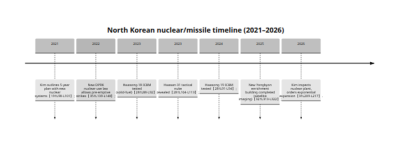
 

Recent Developments and Timeline​

North Korea’s nuclear and missile programme has seen many notable events in recent years. Below is a summary of key activities (tests, weapons unveiled or facilities declared) since 2021:
DateEventSource
Jan 2021Leader Kim Jong Un announces a five-year plan explicitly calling for more tactical nukes and other new weapons.NCNK (North Korea expert group)
Sept 2022New “nuclear use law” promulgated: allows first-use if leadership or state is threatened.DPRK state media, analysis
Mar 2023North Korea publicly reveals a compact tactical nuclear warhead (the “Hwasan-31” bomb).38North analysis
Apr 2023First flight test of the Hwasong-18 solid-fuel ICBM (later declared operational).38North
Aug 2023First launch of submarine-launched cruise missiles from a North Korean destroyer (new sea-based capability).38North
Oct 2024First flight test of the Hwasong-19 solid-fuel ICBM.38North
Jan 2025North Korea conducts high-rate tests of cruise and anti-air missiles, including with its new warships.Reuters
June 2025IAEA Director Grossi reports a new large Yongbyon building “externally complete” – widely believed to be an enrichment plant.CSIS/Beyond Parallel (citing IAEA)
June 2026Kim Jong Un visits a newly operational nuclear fuel processing plant and calls for exponential arsenal expansion.Reuters
1780681409190.png
 
Missile tests: Seoul and Tokyo report dozens of missile launches per year. For example, Japan’s defence ministry counted about 31 ballistic missile launch events (total ~59 missiles) in 2022 alone (mostly short- and medium-range rockets). South Korea notes an unprecedented pace of tests in 2023–24, including new cruise missiles and claimed hypersonic missiles. Many tests of long-range missiles have occurred; however, reliability remains uneven (South Korean officials noted some recent ICBM tests ended in failure). In all, over 200 missile launches (of various types) have occurred during Kim’s rule so far. (Notably, North Korea last tested a nuclear bomb in 2017, but its preparations and nuclear doctrine suggest a further test could be possible.)

Declared facilities: Pyongyang does not allow inspections, but satellite imagery and expert analysis show active nuclear sites. Its 5 MW(e) Yongbyon reactor (plutonium route) has been running since 2016, yielding an estimated few to ~6 kg Pu per year. In 2025, imagery confirmed a large new building at Yongbyon – almost certainly a uranium enrichment plant similar to the Kangson facility. Analysts note it became “externally complete” by mid-2025, with electricity and cooling hooked up. North Korea also reportedly maintains secret centrifuge halls and a smaller enrichment site, giving it a cumulative enrichment output of several thousand separative work units (enough for some tens of kilograms of HEU per year).
 

Arsenal Size and Fissile Production​

Estimating North Korea’s exact stockpile is hard; it’s the most secretive nuclear state. Warheads: Open-source estimates generally put the current inventory at roughly 50–60 assembled weapons, with some capacity to build more. For example, a recent Federation of American Scientists analysis estimated enough fissile material has been produced for about 90 warheads, of which roughly 60 might be assembled as actual bombs. (Reuters similarly reported “around 50” warheads.) The trend is clearly upward.

Capability

Estimate/Range

Confidence

Assembled warheads

~50–60 (likely increasing)

Medium (uncertain)

Plutonium stockpile

~20–60 kg weapons-grade Pu (≈5–17 bombs)

Medium (see note)

HEU/Enrichment capacity

~8,000 SWU/yr (2,000 centrifuges); likely more underway

Low/Med (secret)

Missile force

Numerous SRBMs/MRBMs; several IRBMs/ICBMs (e.g. Hwasong-15/17); new solid-fuel ICBMs; SLBMs under development

High (observed)
Notes: The Plutonium estimate varies with assumptions. South Korea’s defence white paper (2023) cited ~70 kg Pu (up from 50 kg). The NCNK report noted 20–60 kg depending on unconfirmed usage. Converting fissile material to warheads also depends on design and possible composite cores (North Korea likely mixes Pu and HEU in some weapons). HEU capacity is less well publicised but believed substantial, given a modern centrifuge plant and AQ Khan network technology.
Increasing output: State media and analysts report Pyongyang has “more than doubled” its enrichment capacity in recent years. The new Yongbyon plant could significantly boost HEU production. Any added uranium enrichment or resumed plutonium reprocessing would directly increase warhead production. In short, North Korea’s estimated arsenal is relatively small but not static, and the regime is expanding the raw material pipelines to grow it.
 

Delivery Systems and Technical Capability​

North Korea fields a variety of delivery vehicles, many road-mobile and hardened, complicating defence. It has demonstrated missiles with ranges covering all of East Asia and beyond. ICBMs: The Hwasong‑15 (first flown 2017) and likely Hwasong‑17 (claimed in 2022) could in principle reach the continental US. Newer solid-propellant variants (Hwasong‑18 and ‑19) have been tested in 2023–24. These solid-fuel ICBMs take less launch preparation than older liquid ones, improving readiness and survivability. However, re-entry capability remains a question: some US and South Korean officials judged that a recent “Hwasong-17” flight was actually an older model (warhead failed).

SLBMs and naval: North Korea’s sole missile-capable sub (an aging Soviet design) has successfully test‑fired one Pukguksong-1 SLBM (solid fuel) in 2016, but there’s no patrol-capable nuclear sub yet. In March 2025 Kim showed plans for a large new nuclear-powered ballistic missile submarine carrying the yet-untested Pukguksong-6 SLBM. Analysts say such a submarine is years from operational use and would only marginally add to the missile force.

Cruise and SRBMs: Separately, North Korea has developed cruise missiles (ground and sea-launched) with claimed ranges up to ~2,000 km. It’s also fielded many new short-range ballistic missiles that fly maneuverable, low-altitude trajectories (e.g. KN-23, KN-24 series), specifically to complicate missile defences. In late 2021 and 2022 NK claimed to test a hypersonic glide vehicle on an intermediate-range missile. If real, this represents an advanced capability; however outside analysts doubt how manoeuvrable or intercept‑resistant these vehicles truly are.

Warhead miniaturisation: All indications are that North Korea has mastered miniaturizing warheads for its missiles. State media and experts say the nation achieved designs small enough for various launchers by its sixth test. In sum, North Korea likely has functional nuclear warheads for most of its missile types. The main technical uncertainties now are precision and reliability, not basic physics. (Notably, the March 2023 ICBM test reportedly ended in failure, illustrating ongoing reliability challenges.)

In brief, North Korea’s strike systems include:

ICBMs: road-mobile, ranges >10,000 km; recent solid-fuel ICBMs improve readiness.

SLBMs: limited (few tests only); new sub under construction.

MRBMs/SRBMs: numerous solid/fuel and new designs for theatre use.

Cruise missiles: ground‑ and ship‑launched, with ranges ~1,500–2,000 km.

Range-wise, even many short-range systems can reach U.S. bases in South Korea or Japan, while ICBMs could target the American homeland. Reliability remains mixed, but export-grade missiles show North Korea’s engineers are improving quality.
 

Doctrine and Leadership Statements​

North Korea’s leadership portrays its nuclear arsenal as purely defensive deterrence, but its official policy allows force in a range of situations. Kim Jong Un has repeatedly framed nukes as shields against “aggression by the United States and its vassal forces”. He vows never to be “first to use” nuclear weapons as long as the US stops insisting on disarmament – though that pledge is conditional on American behaviour.

In September 2022 Pyongyang codified its doctrine in a new nuclear law. This law proclaims a duty to use nuclear weapons in two cases: first, if North Korean strategic assets or leadership face imminent attack; and second, to “gain the initiative” in a war. In practice, analysts read this as a significantly lowered threshold for first use. The law explicitly rejects any “no-first-use” stance and even allows pre-emptive strikes if the regime deems it necessary. (A Korea Times analysis calls this “escalatory and destabilising” because it embraces first use.)

Official rhetoric stresses deterrence: state media insist the expanding arsenal is needed because of “the US-led bloc’s reckless nuclear threats” and joint war exercises. Kim himself has openly said that US-South Korea drills are “provocations” justifying a “rapid expansion” of North Korea’s nuclear forces. Meanwhile, North Korea proclaims it will not proliferate its nuclear materials to others, and that its weapons serve the goals of state survival, sovereignty and “strategic stability” in the world.

In short, official doctrine is that North Korea’s nuclear force is a deterrent “safeguarding the nation.” Its two declared roles are deterrence and (if needed) “repelling enemy aggression” by possible nuclear counter‑attack. The new law suggests Pyongyang does not rule out a first-use scenario in a conflict, at least as outlined in policy texts.
 

Regional and Global Security Implications​

South Korea and Japan: North Korea’s weapons are a direct threat to its neighbours. South Korea has shifted its own posture (calling the North its “enemy” again) and is dramatically beefing up defences – including plans for nuclear-powered attack submarines and possibly missiles that can strike back at the North. Japan, likewise, has condemned each launch into its waters (calling them threats to peace) and is expanding missile defences (e.g. Aegis Ashore discussions) and deterrence cooperation with the US and South Korea. There is even public debate in both Seoul and Tokyo about whether to arm themselves with nuclear weapons or demand stronger US nuclear sharing – a sensitive issue given their pacifist histories.

United States: US homeland security is at stake as NK ICBMs could target the West Coast. The US reaffirmed its “ironclad” commitment to defend allies, deploying strategic assets and continuing joint exercises. These include THAAD and Patriot interceptors in South Korea, as well as bomber deployments in the region. American policymakers describe North Korea’s arsenal as a “grave” and “direct” challenge to the region, capable of threatening US forces in Asia. For Washington, the chief questions are deterrence credibility and preventing further spread (e.g. exporting technology to other adversaries).

China and Russia: Pyongyang’s traditional patrons have more complicated reactions. China (officially an advocate of Korean peninsula denuclearisation) quietly disapproves of new tests and sanctions violation, but it also opposes regime collapse and largely resists adding harsh measures. Beijing has not publicly rebuked North Korea’s right to self‑defence, though it emphasizes dialogue. If a Chinese leader visit is indeed linked to Kim’s recent nuclear showings, it may signal that China wants to push for talks or maintain influence – but China also worries that a volatile NK could invite US or Japanese pre-emptive moves.

Russia similarly protests North Korean tests but is not seen as acting to restrain Pyongyang; in fact, Russia reportedly is supplying some nuclear reactor parts. Both China and Russia continue to vote for UN sanctions, but enforcement is uneven. Globally, North Korea’s advance adds to proliferation concerns: its technology aid to other countries (e.g. missile exports) is a wildcard.

UN and International law: North Korea is already in formal violation of multiple UN resolutions. Since withdrawing from the NPT in 2003, it has neither legal disarmament obligations nor access to IAEA safeguards. The UN Security Council, by unanimous resolutions (e.g. 1718, 1874, 2270, etc.), forbids any nuclear test, missile launch, or weapons trade by North Korea. In fact, Japan’s defence ministry emphasises that “any missile launch” violates UN sanctions. To date, however, Pyongyang has ignored these constraints. Human rights and humanitarian concerns aside, the expansion of North Korea’s arsenal stands outside the global non-proliferation regime (it is not a Nuclear Weapons State under the NPT) and poses a challenge to the rules.
 

Scenarios and Risk Assessment​

What might come of North Korea’s buildup? The dominant scenario analysts consider is continued stalemate and deterrence. Most experts agree that Kim’s regime seeks to prevent foreign invasion or regime overthrow – not to start a war unprovoked. In a crisis, Pyongyang might threaten nuclear strikes, but actual use is judged a last resort, likely only if the regime feared imminent collapse. (As one commentator put it, Pyongyang wants to “maintain the credibility of the deterrent” while still keeping nuclear options “realistic”.)
Nevertheless, several risk factors are highlighted:
· Misjudgment or miscalculation: North Korea’s missile tests or exercises could spiral accidentally into conflict. For example, a routine ROK-US exercise could be misinterpreted by North Korea as preparation for attack, prompting a provocative launch. Conversely, a North Korean missile falling outside its intended splashdown zone might draw a Korean/Japanese intercept response or false alarm.
· Escalation to nuclear use: If war broke out, the “nuclear threshold” is unclear. The new DPRK doctrine implies it could use nukes even to seize battlefield initiative. A possible scenario is North Korea deploying a low-yield “tactical nuke” against South Korean forces or US bases if it believed its core regime survival was threatened. This would risk massive escalation to strategic war.
· Proliferation: A more remote risk is North Korea exporting nuclear materials or technology. Pyongyang has publicly pledged not to share nukes, but concerns remain (given its history of missile exports to Iran/Syria). A black-market transfer of fissile material or warheads to an anti-American regime would dramatically worsen global security.
On probabilities: experts judge an intentional nuclear strike on civilian populations by North Korea to be low in the absence of war (it would be suicidal for the regime). However, even “safe” deployments of tactical nukes are extremely dangerous. Accident or unauthorized use (e.g. by rogue generals) is considered unlikely but not impossible. Overall, the risk is rising simply because North Korea’s capabilities are growing.

Policy Options and Responses​

Allied responses span diplomacy, sanctions, and deterrence. Below are major policy paths under discussion, with pros and cons:

Option

Pros

Cons

Resume negotiations (e.g. Six-Party talks, bilateral summits)

- May freeze tests or production if incentives offered. - Could buy time or reach an arms-control agreement. - Avoid military conflict.

- North Korea has broken past promises; trust is low. - Diplomacy may legitimize NK’s arsenal without rollback. - May be seen as appeasement, upsetting allies.

Tighten sanctions/enforcement

- Keeps economic pressure on regime; raises cost of weapons. - Unified international stance (UN/US/EU). - Targets financial networks used for nukes.

- Past sanctions have not halted progress. - Harms civilian economy; limited effect if China/Russia tolerate evasion. - NK may respond by accelerating tests, raising stakes.

Strengthen deterrence/defences

- Reassures SK/Japan; deters attack. - Includes advanced missile defences, US troop deployments, joint exercises. - May reduce risk of miscalculation by showing capability to retaliate.

- Provokes North Korea further (“tit-for-tat” militarisation). - Expensive (THAAD, Aegis, subs, missile upgrades). - Strains US-China ties if too aggressive in region.

Arms control frameworks (e.g. no-first-use agreement, freeze-for-freeze)

- Could cap the crisis (e.g. explicit no-first-use by North, or freeze tests vs pause drills). - Diplomacy can lower tensions and build communication channels.

- Difficult to verify; NK historically violates agreements. - Requires heavy concessions for little immediate gain. - Opponents say it rewards bad behaviour without disarmament.

Defensive strategy shift (e.g. South Korea/Japan pursuing their own nukes)

- Regional nuclear deterrence could balance North’s threat. - May pressure North to negotiate.

- Strongly opposed by China and anti-proliferation norms. - Would trigger an arms race in Asia. - Could destabilise NATO alliance (if Europe demands similar rights).
Each option involves trade‑offs. For instance, a recent U.S.-ROK summit reportedly considered enhanced extended deterrence (e.g. deploying US strategic assets) as well as possible diplomatic “engagement” ideas. Some experts advocate a “dual-track” approach: continue pressure (sanctions, defences) while keeping dialogue channels open. Others urge harder lines, even pre-emptive strikes on nuclear sites (though this is widely seen as extremely risky).
 

Expert Perspectives and Debate​

Experts largely agree North Korea has made real progress and will continue to build its arsenal. There is a general consensus that Pyongyang’s nuclear programme now cannot be reversed in the short term. For example, a Federation of American Scientists study noted North Korea “may have produced sufficient material for at least 90 warheads” and is “increasing” its stockpile. South Korean authorities have been blunt, calling the North “our enemy” and warning of additional tests. Even China’s UN ambassador has recently emphasized concern over new DPRK laws governing use.

Areas of disagreement include: how much the West should bargain with Kim’s regime, and how dangerous the situation is. Some analysts stress that North Korea’s strict control and fears of regime survival make deliberate use of nukes unlikely. For instance, despite the bellicose rhetoric, Pyongyang has not tested a bomb since 2017, suggesting it may already feel its deterrent is sufficient. Others caution that even an accidental launch during heightened tensions (say, after joint exercises) could spark a nuclear exchange.

On policy, voices diverge. Proponents of engagement point to the possibility of a diplomatic deal (as in the past “freeze-for-aid” talks) to halt testing. Critics insist the DPRK treats diplomacy as a ruse and say only a robust military deterrent will prevent war. There is debate over how closely China would enforce sanctions, or whether new multilateral talks could have any chance.

In the end, the threat of North Korea is there. While North Korea does not want to use nuclear weapons, the consensus is that they will if deemed necessary. The threshold of what North Korea might deem as “necessary” is debated, but the concern is that it is lower than what the United States, Russia, or China may have for nuclear use.
 
We need to recognize DPRK as a legit nuclear state and lift the sanctions. They got them, and no way we are taking them away without too great of a loss to us and our allies. So, time to lift the sanctions and recognize DPRK as a legitimate nuclear power. Hate to say it, but they won.

The ONLY way to do what I mentioned above is if we give them the means or ROK makes their own nukes too. Then we can pull out of ROK and let the two deal with their differences. Both will be on equal footing then, and M.A.D. will prevent them from waging a war.

It's not something we can just do overnight and pull out overnight. ROK would have to build up its military, including building up a nuclear force, before we could leave them and let them defend themselves and work out their differences themselves with their neighbors.

But in my opinion, that would be the best way to create less tensions and a more peaceful Asia if we recognize North Korea as an official nuclear state and lift the sanctions. At least it would be a good start. But again, so long as ROK and Japan can and do develop their own nukes too.

That's why I believe ROK/Japan should and will create their own nuclear arsenal and beef up their militaries. Of course they'll never be friends with DPRK, but that doesn't mean we have to keep hostile relations either by sanctioning them for something they already have, nukes, and now will always have no matter what.

DPRK is here to stay, and so are their nukes. Think it's time we accept that and try to normalize relations or normalize life around that somewhat, and also withdraw from the area once ROK/Japan have nukes and a sizable military to defend themselves.

I say, why risk accidental nuclear war by maintaining such high hostilities over their nuclear weapons when they are there to stay? They won. It's over. Time to move on with our lives before we blow it up over a hair trigger mistake that isn't necessary anymore to be on hair triggers with them.
 
Lastly... To really hammer it home. We need to stop pretending North Korea’s nuclear arsenal is temporary. The DPRK is a de facto nuclear state, and there is no realistic path to disarming it without imposing IMPOSSIBLE & UNACCEPTABLE costs on the United States, South Korea, Japan, and the wider region.

We may not like it, but strategically speaking, Pyongyang achieved its core objective, I.E regime survival through nuclear deterrence. ✅🏁

Realistically they are no threat so long as we recognize them as a legit nuclear state and lift the sanctions over their nuclear program. Who knows. Doing so may see the opportunities to draw down troops or artillery on the DMZ and much more. But can only get to a stable coexistence if we admit the reality on the map which is North Korea has nuclear weapons and that's never ever ever ever ever ever going to change now and WE MUST figure out how to live with it without constantly living near the cliff of the abyss of total nuclear annihilation.
 
Back
Top Bottom