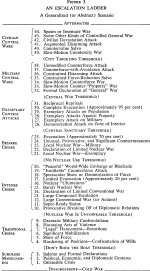
It’s called Ukraine is losing. There’s a principle of war called Khan’s escalatory ladder.
View attachment 4338
We are about to cross to 21 having skipped 16. That’s what changed. PLEASS NOTE THIS APPLIES TO THE UKRAINIAN THEATER ONLY AT THIS TIME.
21. Local Nuclear War -- Exemplary
22. Almost every analyst now agrees that, with the possible exception of Rung 19-type tactics, the first use of nuclear weapons—even against military targets —is likely to be less for the purpose of destroying the other side's military forces or of handicapping its operations than for redressive, warning, bargaining, punitive, fining, or deterrence purposes. As this would be the first unmistakably deliberate use of these weapons since World War II, it would be a profoundly consequential act, even if very limited and specialized.
23. Declaration of Limited Nuclear War
24. At this point, it might be judged desirable to make a formal declaration of limited nuclear war—perhaps in hope of setting out relatively exact limits and establishing expectations about the types of nuclear action that the declarer intends to initiate and that he is prepared to countenance from the enemy without escalating further himself.
25. Local Nuclear War -- Military
26. It is also possible that nuclear weapons could be used in a local situation for traditional military purposes such as defense, denial, destruction, or degradation of the opponent's capability, and so on, and that, within the established limits, the scale and targeting would be, and would be acknowledged to be, dictated by wholly military and "tactical" considerations.
27. Unusual, Provocative and Significant Countermeasures
28. One side might carry out redeployments or maneuvers that would have the effect of shifting the balance of power by increasing an opponent's vulnerability to attack or otherwise degrading its capability, morale, or will.
29. Evacuation (70%)
30. At this point, the situation may be very close to large-scale war. It may now seem advisable to evacuate a large number of people from cities. The total would probably amount to between two-thirds and threefourths of the population—women and children and those men who are not essential to the functioning of the cities. I would judge that all important industries, communications, transportation facilities, etc., could be operated by about a quarter of the population or less.