• Guests may view all public nodes. However, you must be registered to post.

🕵️‍♂️ | UA-NATO/RU | Prevalent Crisis Environment | REPORTS

🇪🇪🇱🇹🇹🇷🇮🇹
NATO’s Baltic mission transitioned from air policing to integrated air defense expanding its authority to respond to aerial attacks and rapidly deploy reinforcements.

Turkey leads the first Estonian rotation with five F-16s and approximately 80 personnel at Amari. Italy assumed the Lithuanian component with four Eurofighters and around 200 personnel.

➡️This is a substantive mission upgrade, not merely a routine rotation.

🔗⤵️
 
🇭🇺🪖
Hungary opened a military re-admission process for personnel dismissed during the 2023 “rejuvenation” reductions and those who lost service status after declining COVID vaccination.

Returnees may resume service at their previous rank and salary, although not necessarily in their former post. More than 270 people attended the initial briefing.

🔗⤵️
 
🇬🇧🇺🇦🛡️🚀
Britain and Ukraine began discussing possible joint anti ballistic and air defense projects.

Talks covered potential British participation, possible air defense and Meteor missile assistance, and counter Shahed systems potentially financed through revenue from frozen Russian assets.

No British funding, procurement or delivery commitment has been announced.

🔗⤵️
 
🇷🇴🛸
Romania’s Defence Ministry said an unidentified aerial target entered national airspace on August 2nd, flying over Romanian territorial waters and along the Sulina branch for approximately 20 minutes. Two Romanian F-16s monitored but did not engage the target.

It returned to Ukraine, where Ukrainian forces downed it. Debris fell on agricultural land near Periprava, approximately one kilometer inside Romania. No casualties or damage were reported; the target’s type and origin remain unidentified.

🔗⤵️
 
🇺🇸🇪🇺🇺🇦🛡️
EUCOM has begun transferring Ukrainian training, materiel management & sustainment responsibilities from Security Assistance Group Ukraine to NATO Security Assistance and Training for Ukraine. U.S.-specific functions will transfer to U.S. Army Europe and Africa and other EUCOM components before SAG‑U is dissolved.

Lt. Gen. Guillaume Beaurpere assumed command of both organizations on August 3rd. EUCOM expects a European or Canadian officer to command NSATU within approximately one year, with an American serving as deputy commander. The transition remains underway and does not represent reduced support for Ukraine.

🔗⤵️
 
🇷🇺🇹🇷🚢🛸
The Turkey RoRo ship NADEZHDA was attacked approximately 20 nautical miles from Novorossiysk on August 3rd while sailing to Samsun. The vessel’s accommodation area and bow were damaged and remained on fire.

Russian maritime units evacuated all 22 crew members, including 13 Turkish citizens, to Novorossiysk. Turkey maritime authority initially reported that three crew members might be seriously injured and said salvage could not begin because of the risk of further drone attacks. The attack has not been attributed.

🔗⤵️
 
🇫🇮✈️🛸
The Finnish Defence Forces temporarily established and subsequently lifted an aviation restriction area in the eastern Gulf of Finland during overnight drone activity near St. Petersburg.

No penetration of Finnish airspace, interception or engagement was reported. Public reporting did not specify the restriction’s duration or indicate effects beyond the precautionary closure.

🔗⤵️
 
🇰🇵🇷🇺🇺🇦🚀
Ukraine’s Main Directorate of Intelligence told Reuters that approximately 90 North Korean personnel are deploying to Russia’s Voronezh region within the 112th Missile Brigade.

Kyiv says 40 KN-23/KN-24 ballistic missiles and associated personnel have already arrived. The deployment could eventually include six launchers and 120 missiles, although its final configuration and the personnel’s operational role remain unclear. Reuters could not independently verify the intelligence.

🔗⤵️
 
🇬🇧🚢🛡️
The UK Ministry of Defence awarded BAE Systems a £135 million contract to sustain the Royal Navy’s Spearfish heavy torpedoes and Sting Ray lightweight torpedoes.

The Torpedo Repair and Maintenance contract runs from July 2026 through June 2029 and covers weapons used by submarines, surface vessels and maritime patrol aircraft. It bridges to the planned WHITEHEAD2 support program beginning in 2029 and does not procure additional torpedoes.

🔗⤵️
 
🇪🇺🇺🇦💶
The European Union has made an additional €1.4 billion in proceeds generated by immobilized Russian central bank assets available to Ukraine.

The funds, derived from interest generated by frozen Russian cash balances, were transferred to the EU on August 3rd. The measure concerns proceeds generated by the assets and does not confiscate the underlying Russian principal. A sectoral allocation and disbursement schedule were not disclosed.

🔗⤵️
 
🇩🇪✈️🛸
An unidentified flying object near Leipzig/Halle Airport prompted the suspension of operations and diversion of several aircraft at approximately 23:40 on August 4th. Police also found an unidentified object near the southern runway and deployed an explosives disposal robot.

Separately, a DHL cargo aircraft collided with an unknown object shortly after departing Leipzig and made an unscheduled landing in Hanover. Authorities have not identified or publicly linked the aerial sighting, runway discovery and aircraft collision. Claims that a Ukrainian transport aircraft was targeted remain unconfirmed.


🔗⤵️
 
🇷🇺🇺🇦🚀
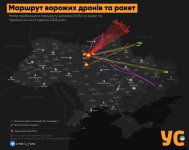
Russia launched 24 Iskander M/S-400 ballistic missiles, four Zircon/Oniks missiles and 115 drones against Ukraine overnight. Ukraine reported destroying or suppressing 98 drones but intercepting none of the missiles.

At least 17 people were killed and more than 40 injured in Kyiv and the surrounding region. Ukraine reported strikes on civilian logistics facilities, infrastructure and a railway station. Russia said it targeted seven logistics centers allegedly storing dual use goods and drone components.

🔗⤵️

@DEFCON Warning System @RiffRaff @Irag8er @Torch @Sentry
 
€454 Billion: Europe’s Defence Wake-Up Call:
EU defence spending is set to hit €454 billion in 2026 - surpassing China and Russia combined.
By 2030, at least 40% of equipment will be procured jointly, rising to 60% from European industry by 2035.
The aim is clear: a more unified defence industry, faster production, and reduced reliance on external suppliers. After decades of underinvestment and fragmentation, Europe is finally building the capacity for genuine strategic autonomy. The money is there. Now it must be turned into real military strength.
 

Over the last few weeks, the situation for Ukraine on the frontline has rapidly deteriorated in an unprecedented manner not seen since early 2025.
In the northeastern corner Kharkiv Oblast, Russia has achieved two localised breakthroughs, threatening to encircle more than 360 km² of Ukrainian-controlled territory.In the Dobropillya direction, one of the most formidable Ukrainian strongholds which has stood for over a year has been breached, with Russian forces now flooding Ukrainian positions in the urban agglomeration between Pokrovsk and Dobropillya.
In the Kramatorsk/Slovyansk direction, Ukraine has been unable to slow down Russian advances, with Russia now coming within 4.7 km of both Slovyansk and Kramatorsk, and coming close to fully capturing the crucial tactical ridgeline east of these two final Donbas cities.
In the Kostyantynivka direction, Russia has captured Chasiv Yar after 840 days of battles, and has almost completed the capture of Kostyantynivka. The salient west of Chasiv Yar is falling apart day by day as Ukraine withdraws.In the Druzhkivka direction, Russia achieved a localised breakthrough of up to 6 km, capturing 3 villages and entering 3 others, coming within 5.1 km of Druzhkivka, and threatening the Ukrainian salient west of Kostyantynivka with encirclement.In the Omelnyk direction,
Russia has finally captured the Ukrainian stronghold town of Zaliznychne after over 7 months of battles, and are making new advances west of the Haichur River towards Vozdyvzhivka.
In the Stepnohirsk direction, Russia has halted the Ukrainian counterattacks and have begun retaking previously lost ground, advancing northeast of Kamyanske and north from Mali Shcherbaky.
In the Kupyansk direction, the crucial Ukrainian bridgehead east of the Oskil River continues to shrink day by day, with Russian forces expanding their zone of control in the area of Novosynove, Kivsharivka, Pishchane, Petropavlivka, and Kupyansk itself.
Ukraine is losing incredibly important defensive positions necessary for holding the frontline in the future, especially the areas south of Dobropillya which should not be falling this quickly. However, they are seemingly intent on concentrating their assault forces in counterattacks north of Lyman, west of Komar, and south of Novopavlivka, which have questionable (at best) strategic reasoning for the heavy cost being endured.
The new Ukrainian Commander-in-Chief Mykhailo Drapatyi has inherited a situation that is getting worse by the day, and will have to make some serious and difficult decisions in order to try stabilise it towards the end of Summer.
 
Last night, Ukraine was unable to shoot down any of the 28 missiles launched by Russia: 24 ballistic missiles and 4 hypersonic "Tsircon" missiles.
Since last Saturday alone, over 50 ballistic missiles have been launched at Kyiv and nearby.Reports that the United States spent the bulk of its interceptor missile stocks in Iran appear to be accurate; the US is experiencing shortages and is now unable to supply them in the quantities Kyiv needs. It must be understood: there are no Patriot interceptor missiles available in the necessary quantities, and there will not be, given the scale of Russian and allied missile production and the intensity of the attacks.

This raises monumental questions about how Ukraine will navigate through the winter season - if Ukrainian energy infrastructure remains defenseless and is destroyed, it will lead to a humanitarian catastrophe and a massive wave of migration into the EU.

Currently, not only Ukraine but also Europe remains unprotected. Will Russia wait several years for the realization of the joint Ukrainian-European ballistic missile interceptor project "Freyja" without attacking Europe? It is best not to wait for an answer to this question, but to act preemptively.

There are currently two obvious ways to eliminate the ballistic threat.

1. Strikes on enterprises involved in the supply chain of critical components - primarily solid-fuel rocket motors. A massive strike using drones and "Flamingo" missiles must be carried out against them to induce fires. This also includes continuing strikes against the assembly plant in Votkinsk, Udmurtia. One successful strike with a "Flamingo" missile was already carried out there in February of this year. This effort must be sustained with a coordinated barrage of both "Flamingo" missiles and drones.
2. Destruction of Russian launchers. This requires thorough daytime reconnaissance of storage sites for "Iskander" launchers in the Bryansk and Kursk regions, as well as their nighttime movement routes toward launch pads, the list of which is limited. To achieve this, close coordination with partner intelligence services regarding launch site data is essential. The US possesses reconnaissance satellites capable of tracking the nighttime movement of "Iskanders" to launch locations using infrared and radar sensors. If such information were provided and shared with Ukraine, it would be possible to attempt strikes on "Iskander" columns using Fire Point drones equipped with mesh networking, capable of maintaining stable communications at a depth of 150–200 km.The Russian ballistic threat poses a danger to all of Europe. Failing to counter it now, before winter arrives, could lead to irreversible consequences.
: Russian attacks last night
HO9XNiTX0AAvgDv.jpg


https://x.com/Gerashchenko_en
Anton Gerashchenk
 
Russia is reportedly targeting one of the most critical pieces of civilian infrastructure serving Kyiv.
According to Ukrainian analysts, repeated ballistic missile strikes are aimed at the region’s only wastewater treatment facility, raising fears of a potential humanitarian disaster.
The head of the Eidos Analytical Center says Russia is systematically attacking the sole aeration station responsible for treating wastewater from Kyiv and surrounding cities. According to the assessment, there is no backup system capable of replacing the facility.
A successful direct strike on this critical infrastructure could trigger consequences that experts say are impossible to fully predict at this stage.
If the facility were to be put out of operation, the impact could extend far beyond the capital itself, affecting public health, sanitation, and essential services for millions of people.
 
🇩🇪🛸🧨
UPDATE: German authorities confirmed that the object discovered inside Leipzig/Halle Airport’s restricted cargo zone was a drone carrying explosives. Specialists removed its detonator, while anti extremism prosecutors and counterterrorism officers assumed the investigation.

Interior Minister Alexander Dobrindt described the incident as a hybrid attack and a new threat scenario. Investigators have not identified the explosive, drone origin, operator or sponsoring actor. A nearby Ukrainian aircraft may have been the intended target, but this remains unconfirmed.

🔗⤵️

@DEFCON Warning System @RiffRaff @Irag8er @Torch @Sentry
 
Here are two reports containing some additional information, taken from the "Tagesschau" website. The "Tagesschau" is germany's most important (and oldest) news broadcast, airing in the public-service television station ARD.

The translation was done by the Google Translator, then proof-read and, where needed, improved or rephrased by me. I have kept the original formatting with the sub-headlines.

Leipzig / Halle Airport: Drone with explosives and detonator discovered

05.08.2026 // 21:41

A suspicious object was found at Leipzig/Halle Airport. According to reports by NDR, WDR, and the "Süddeutsche Zeitung", it is a drone rigged with the explosives PETN and Semtex.
(novaB - annotation: NDR and WDR are part of the public service broadcasting conglomerate ARD; the "Süddeutsche Zeitung" is a reknowed newspaper that works together with the ARD in investigative journalism, they are abbreviated as "SZ".)

New details regarding the police operation following last night's incident at Leipzig / Halle Airport are coming to light. According to insights by NDR, WDR, and the SZ, airport staff discovered a drone - apparently rigged with explosives - reportedly located in the immediate vicinity of four cargo planes belonging to the Ukrainian state-owned carrier "Antonov Airlines".
Confidential official documents reveal that a package containing a suspicious substance had been attached to the drone; a memo notes that the package also contained a detonator. The documents also outline the results of several forensic tests.


PETN and Semtex found

According to the records, an initial examination by bomb disposal specialists gave a positive result for the presence of nitrates, which are explosive substances. A second and a third test initially yielded negative results, a fourth test conducted by experts from the Saxony state police however revealed that the package contained the highly explosive materials PETN and Semtex. These substances are also used in military applications.
Investigations suggest that the airport narrowly averted a catastrophe. The documents indicate that the detonator on the attached package had apparently been torn off, thereby preventing an explosion.


Plane collides with object

According to police reports, a further incident occured in connection with the discovery. A cargo plane, unable to land due to the closure of the airport, collided with another object at an altitude of several hundred meters in the vicinity of the airport. After landing at an alternate airport in Hannover, federal police officers documented minor damage to the aircraft's front.

According to an official memo, the Lower Saxony police are classifying the case as a potential offense against state security. The Federal Ministry of the Interior later confirmed the incident. A DHL spokesperson also stated that an aircraft had collided with an "object."
Leipzig Airport serves as a hub for military goods, including those related to the war in Ukraine. It narrowly avoided a catastrophe just two years ago: at that time, a package bound for the UK caught fire while still on the ground at a DHL logistics center. Investigations revealed that the incident was an operation by Russian intelligence services. Five suspected members of the alleged sabotage network are currently facing trial in Lithuania.


Increased drone sightings since the war in Ukraine began

Since the start of Russia’s war of aggression against Ukraine, there has been an increase in drone sightings and the surveillance of critical infrastructure and military facilities in Germany. In the first half of the year alone, German air traffic control recorded 145 instances of operational disruption caused by unauthorized drone flights in the vicinity of German airports. In most cases, the authorities are unable to identify the drone pilots. In July, a 37-year-old person from Moldova was arrested in Bavaria on suspicion of using a drone to spy on a defense company. He was taken into custody after members of the public reported his presence near the company premises. The attorney general of Munich's prosecutor's office is investigating the case; security sources suggest the suspect may have been acting on behalf of Russian intelligence services.
Link to the article (german)


Drone at Leipzig/Halle Airport: Dobrindt sees "hybrid attack scenario"

05.08.2026 // 23:35

(Annotation by novaB: Alexander Dobrindt is Germany's interior minister, and in that position internal security is one of his areas of responsibility. He is from the conservative Bavarian party CSU.)

Authorities are alarmed following the discovery of a drone carrying explosives at Leipzig/Halle Airport. Federal Interior Minister Dobrindt spoke of a "new level of danger."

According to Federal Interior Minister Alexander Dobrindt, the discovery of a drone equipped with an explosive device at Leipzig/Halle Airport represents "a new level of danger." Speaking in one of the airport's buildings on that evening he assessed "that we are dealing with a hybrid attack scenario here," the CSU politician said. "The fact that a drone, armed with explosives is located here on airport grounds — that is a new threat scenario."
Dobrindt does not believe the plotters are amateurs, as he later explained in an interview with "Tagesthemen" (novaB: the late edition of the "Tagesschau"). While he did not wish to engage in speculation, he noted that state actors could be involved: "It could be foreign powers," he said regarding the drone's originators. "In any case, it cannot be ruled out."
According to Dobrindt, the incident marks the first case in Germany involving a drone loaded with explosives. Based on current findings, it must be assumed that the materials involved are military-grade explosives. "We need to be aware that this threat exists," the Federal Interior Minister explained. For this reason, he had already upgraded the official threat assessment from an 'abstract threat' to a 'high-level threat' weeks ago.


Second incident involving a cargo plane

Flight operations at Leipzig/Halle Airport were briefly suspended around midnight following a drone sighting. Staff subsequently discovered a drone equipped with explosives; experts from the Federal Police defused its detonator. In a second incident that night, an unidentified object collided with a cargo plane, which subsequently landed in Hannover with minor damage.
It remains unclear where the objects originated and whether the incidents are connected. The Dresden public prosecutor's office and the Police Center for Counter-Terrorism and Counter-Extremism - based at the State Office of Criminal Investigation - have launched an investigation.
According to investigations by NDR, WDR and SZ, the airport narrowly averted a disaster with the explosives-ladden drone. The report, citing investigative documents, stated that the detonator on the attached package had apparently been torn off, thereby preventing an explosion. According to security sources, the drone was located near an Ukrainian transport aircraft.


ARD Expert: "A New Level"

Leipzig/Halle Airport is considered a hub for military supplies destined for the war in Ukraine. Since the start of Russia's war of aggression against Ukraine, Germany has seen an increase in drone sightings and the surveillance of critical infrastructure and military facilities.
Speaking on the "Tagesschau" news program, ARD's security expert Holger Schmidt described the incident as an attempted attack: "We have been discussing the dangers drones can pose at airports for some time," he said. "But explosives and detonators - that represents a new level of threat for Germany. That is why today is a very tense day for German security authorities, and why this is a deeply worrying development."


Is Russia behind it?

German airports are not sufficiently protected against such attacks yet, even though much has been done in recent months and years, said Schmidt. According to security expert Nico Lange, the incident in Leipzig fits "the pattern of Russian hybrid attacks against Germany." It is "highly likely that this was such a hybrid attack," Lange told the television channel Phoenix. (novaB: A channel for news and reports from politics, part of the german public service broadcasting network.)

Link to the article (german)
 
Last edited:
Back
Top Bottom