

-
Guests may view all public nodes. However, you must be registered to post.
You are using an out of date browser. It may not display this or other websites correctly.
You should upgrade or use an alternative browser.
You should upgrade or use an alternative browser.
Iran Attacks Israel & Awaiting Purported Israeli Attack on Iran | Reports
- Status
- Not open for further replies.


 ️IDF says it killed top Hezbollah money man in Syria strike

NuclearID
Guest


DOD, FBI investigating suspected major intelligence leak:
The FBI and Defense Department are investigating what could be a significant intelligence breach, disclosing what appears to be classified information about Israel’s plans to strike Iran, U.S. officials said Monday. Two leaked documents seem to divulge US analysis on Israel's plans against Iran. Earlier this month, Israel vowed to retaliate against Iran for its Oct. 1 missile attack, when Iran launched 200 missiles at various targets inside Israel. It wasn't clear, however, how or when Israel would respond. Amid speculation on Israel's next move, two documents marked "top secret" surfaced on social media last week that purported to show analysis by the U.S. military on Israeli operations.
One document purports to be from the National Geospatial-Intelligence Agency (NGA), a military agency that collects, analyzes and distributes intelligence gleaned from satellite and aerial imagery. The second claims to contain intelligence generated by the National Security Agency. (NSA). ABC News is not quoting directly from or showing the documents, which appear to detail movement of Israeli military equipment and munitions that could be used in a potential strike. One of the documents claimed Israel could strike Iran without the U.S. seeing any further visual clues from above. According to one person familiar with the investigation, the FBI was investigating the leak as part of a criminal probe. The White House said Monday the Defense Department was also investigating the disclosure and that officials have discussed the suspected breach with Israel.
"We're deeply concerned, and the president remains deeply concerned about any leakage of classified information into the public domain. That is not supposed to happen, and it's unacceptable when it does, so he's deeply concerned about that," White House national security spokesperson John Kirby told reporters on Monday. Kirby said there is no indication more documents could be released, but "we're certainly going to keep our antenna up and our eyes open for any potential future disclosures." It's not clear yet if the documents were leaked by an insider or stolen by a hacker Both documents have markings indicating that, if authentic, they would have been shared with the so-called Five Eyes, the intelligence-sharing alliance made up of the United States, Australia, Canada, New Zealand and the United Kingdom.
The documents surfaced on a Telegram channel called Middle East Spectator, an anonymous blog that frequently publishes pro-Iran content. The channel's administrator told ABC News they obtained the documents through an acquaintance who received them from an unknown source. The administrator denied being affiliated with any government. The documents have markings indicating that, if authentic, they would have been shared with the so-called Five Eyes, the intelligence-sharing alliance made up of the United States, Australia, Canada, New Zealand and the United Kingdom. It's possible that a foreign entity such as the government of Iran stole the documents by hacking the systems of nations with access to the intelligence. But at least one official familiar with the investigation said the probe will focus aggressively on anyone who works for or with the U.S. government and had access to the material.
Earlier this year, Massachusetts Air National Guardsman Jack Teixeira pleaded guilty to six counts of willful retention and transmission of national defense information. According to prosecutors, Teixeira leaked information in a Discord chat room on the type of equipment the U.S. was sending Ukraine, troop movements in Ukraine and a plot by a foreign adversary to attack U.S. forces abroad.

DOD, FBI investigating suspected major intelligence leak
The Defense Department and the FBI are investigating what could be a significant intelligence breach about Israel's plans to strike Iran.
 abcnews.go.com
Last edited by a moderator:
NuclearID
Guest
Leaks and spy rings merely delay the inevitable Israeli operation:
Allegedly leaked documents from the US National Security Agency and the National Geospatial-Intelligence Agency, paired with Tehran’s ongoing intelligence operations, seek to disrupt Israel’s plans of responding to Iran’s recent ballistic missile assault on Israel. Regardless, Iran is bracing for an Israeli attack that may target its nuclear facilities, and Israel remains undeterred, especially following Hezbollah’s failed attempt to eliminate Israeli Prime Minister Benjamin Netanyahu.
The alleged leak, described by CNN and Axios as a major security breach, supposedly outlines the scale of Israel’s potential attack against the Islamic Republic. Published on October 17 on the pro-Iranian “Middle East Spectator” Telegram channel, the two documents are labeled “top secret” and contain notes specifying they are intended exclusively for the United States and its “Five Eyes” partners: Australia, Canada, New Zealand, and the United Kingdom. The satellite analysis allegedly compiled by the US National Geospatial-Intelligence Agency states that the Israeli Air Force (IAF) has been handling air-launched ballistic missiles (ALBMs) and has moved various munitions around, while there is no indication of an intended use of nuclear weapons.
The other document that appears to be sourced to the National Security Agency outlines recent activities conducted by the IAF, including air drills, intelligence operations, and the relocation of advanced-weaponry munitions. The leak alleges that the IAF transferred 16 Golden Horizon missiles, likely an Israeli Sparrow missile variation that was used to strike an Iranian S-300 outpost located close to the Natanz nuclear facility. The document added that Israel had relocated 40 ROCKS IS02 stand-off range air-to-surface missiles developed by Rafael Advanced Defense Systems. The file also claims that the IAF conducted two air drills on October 15–16, training air-to-air refueling with three KC-707 tankers and one Gulfstream G550 aircraft. Further, it indicates that the IAF installed concealment screens over six F-15I fighter jets capable of firing ALMBs and suggests Israel has been deploying surveillance UAVs to monitor different targets. This is not the first instance in which leaked documents have revealed the imminent threat of a large-scale Israeli attack on the Islamic Republic. In 2012, Foreign Policy reported that Israel was planning on striking Iran’s nuclear facilities via airbases in the Republic of Azerbaijan. The seemingly intentional leak allegedly disrupted the operation from taking place, with many officials claiming that elements within the US administration at the time sought to prevent Israel from striking Iranian nuclear sites.
Meanwhile, Israel recently uncovered a spy ring led by Tehran consisting of seven Israeli-Azerbaijani dual nationals. Prosecutors stated on October 21 that the suspects had allegedly collected information on Israel Defense Forces (IDF) facilities, including the Nevatim and Ramat David Airbases that were struck by Iranian ballistic missiles and Hezbollah in the last few weeks. The defendants are also accused of gathering intelligence on Iron Dome batteries, ports, energy infrastructure, and an unnamed “senior security figure.” Despite the leaks and Tehran’s intelligence operations, the regime still expects a strong Israeli response that could target Iranian nuclear facilities. A day after the leak, Iranian Minister of Foreign Affairs Abbas Araghchi threatened that “the necessary response will be given to any attack on Iran’s nuclear facilities or any similar attack.” Echoing these remarks, Iranian Foreign Ministry Spokesperson Esmail Baghaei confirmed that Tehran has submitted a formal letter to the International Atomic Energy Agency (IAEA) arguing that an attack on Iranian nuclear infrastructure is not permissible under UN Security Council Resolution 533.
A recent escalation by the Iran-led Axis of Resistance has further pressured Israel to carry out a strong response. A drone launched on October 19 by Hezbollah struck the residence of Israel’s prime minister, urging Netanyahu to promptly issue a warning: “The agents of Iran who tried to assassinate me and my wife today made a bitter mistake.” Seemingly aware of its miscalculation during heightened tensions, Iran was quick to backpedal on its ties to the attack. Tasnim News, closely affiliated with the Islamic Revolutionary Guard Corps, first hailed the attack as a “historical event,” only to swiftly distance itself by claiming that “Hezbollah’s involvement in the attack is contested.” Similarly, the Islamic Republic’s mission to the United Nations denied any involvement in the assassination attempt. Israel supposedly remains undeterred by the recent Hezbollah attack and Tehran’s threats. The Israeli N12 News cited anonymous political officials claiming that Jerusalem’s response will intensify as a result of the UAV attack. The Israeli Security Cabinet finalized a six-hour meeting on October 20, discussing Israel’s upcoming operation and agreeing to last-minute approval of the strikes to ensure operational security.
Last edited by a moderator:
NuclearID
Guest
Initial investigation into US intelligence leak on Israeli attack planning focusing on who had access to documents:
The publication on social media of two classified US intelligence documents detailing Israeli preparations for an attack on Iran has set off a scramble inside the US government to discover how they were leaked, a closely held investigation in its early stages that is zeroing in on who had access to the documents. On Monday, the White House said publicly that there are presently no indications that more documents beyond those two had been leaked or would be published. But the exposure of the two documents — which appeared to have been produced by two Defense Department intelligence entities, the National Security Agency and the National Geospatial Intelligence Agency — has deeply alarmed American officials at a profoundly sensitive moment in US-Israel relations.
The FBI is leading the investigation, working with Pentagon investigators and the intelligence community, according to US officials briefed on the matter. In recent days, investigators have worked to authenticate the documents and determine who could have had access to them, the officials said. That focus is one indication that, for now, the FBI and other investigators are working off the theory that the breach most likely came from a government insider and not from a cyber intrusion. Both documents were widely accessible products, according to two sources familiar with US intelligence. But at least one appears to be scanned from an officially printed briefing book. That could provide investigators with a critical jumping-off point: The Defense Department, like other federal agencies, tracks when employees print classified documents. The pool of people who printed these pages would be relatively small, these sources said. But the investigation is still considered to be in its early stages, so no conclusions have been made, the officials say.
The FBI declined to comment.
National Security Council spokesman John Kirby told reporters Monday that officials do not yet know how the documents were released and that the Department of Defense is continuing its investigation. Kirby also said that “at this time” they have no reason to believe similar documents will be released. “We don’t have any indication at this point that there’s an expectation that there will be additional documents like this finding their way into the public domain,” he said. The documents, dated October 15 and 16, began circulating online Friday after being posted on Telegram by an account called “Middle East Spectator.” They are marked top secret and have markings indicating they are meant to be seen only by the US and its “Five Eyes” allies — Australia, Canada, New Zealand and the United Kingdom. One of the documents, which says it was compiled by the National Geospatial-Intelligence Agency, says the plans involve Israel moving munitions around.
Another document says it is sourced to the National Security Agency and outlines Israeli air force exercises involving air-to-surface missiles, also believed to be in preparation for a strike on Iran. CNN is not quoting directly from or showing the documents. Highlighting the sensitive nature of the leak, American officials were extremely tight-lipped about the investigation on Monday. Officially, multiple agencies declined even to confirm that an investigation is ongoing. In a statement over the weekend, the Middle East Spectator account said it was “not aware of any additional leaked classified U.S. documents” and that it had “no connection to the original source, which we assume to be a whistleblower within the U.S. Department of Defense.” According to one US official, it wasn’t what the documents described that is so worrying to the intelligence community but rather the fact that they leaked at all. Although it’s quietly accepted that the US spies even on its allies, to have American surveillance of Israel leaked publicly risks straining relations at a moment when the US is desperately trying to bring to a close the series of interconnected conflicts in which Israel is now embroiled.
NuclearID
Guest


NuclearID
Guest
Blinken visits Jordan on Wednesday to push for a ceasefire in the region.
NuclearID
Guest


Iran tells UN: Biden has signaled US approval, support for attack on Iran:
Oct 21 (Reuters) - U.S. President Joe Biden has signaled "tacit approval and explicit support for Israel's unlawful military aggression against Iran," Iran's mission to the United Nations said on Monday, citing remarks by Biden in Germany last week.
"The United States will bear full responsibility for its role in instigating, inciting and enabling any acts of aggression by Israel against the Islamic Republic of Iran ... as well as for the catastrophic consequences on regional and international peace and security," Iran's U.N. mission said in a letter to the U.N. Security Council.
Biden, on a visit to Berlin, also told reporters he has an understanding of how and when Israel will respond to the missile attacks by Iran. He declined to elaborate.


- Joined
- Apr 12, 2018
- Location
- Australia
- Joined
- Apr 12, 2018
- Location
- Australia
Reports of an Impact from a Hezbollah Rocket or Missile near the Town of Beit Aryeh in the West Bank.
- Joined
- Apr 12, 2018
- Location
- Australia
Blinken lands in Israel


- Joined
- Oct 16, 2016
NuclearID
Guest
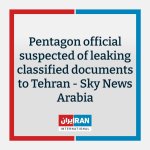
#Leak #UpdateA Pentagon official told Sky News Arabia that a senior employee in US Defense Sec. Austin 's office is under suspicion for leaking classified documents to Tehran.
The official noted that the employee in question holds a security clearance granting access to highly sensitive information. Furthermore, the suspected individual serves as the director within the Office of the Assistant Secretary of Defense for Special Operations.
Previously, it was reported that the US is investigating the leak of highly classified intelligence regarding Israel’s plans for retaliation against Iran.


- Joined
- Jan 23, 2020
Welp, there you have it everyone. The Pentagon and DoD is compromised.
The suspected leaker of classified Pentagon documents on Israel's planned attack on Iran was identified as Ariane Tabatabai, an Iranian American with access to highly classified secrets, Sky News Arabic said on Tuesday.
The suspected leaker of classified Pentagon documents on Israel's planned attack on Iran was identified as Ariane Tabatabai, an Iranian American with access to highly classified secrets, Sky News Arabic said on Tuesday.



- Joined
- Apr 7, 2016
- Location
- Indiana, US
UNCONFIRMED
Seeing multiple Twitter accounts stating a massive explosion has occurred over Central Israel, with the blast being heard as far away as Beersheba (approximately 40 miles).
No photos or video to substantiate, but thought I should post what I'm seeing.
UNCONFIRMED
Seeing multiple Twitter accounts stating a massive explosion has occurred over Central Israel, with the blast being heard as far away as Beersheba (approximately 40 miles).
No photos or video to substantiate, but thought I should post what I'm seeing.
UNCONFIRMED
- Joined
- Jan 23, 2020
NuclearID
Guest
 ALERT
JORDAN FOREIGN MINISTRY SAYS U.S. BLINKEN'S VISIT TO KINGDOM DUE ON WEDNESDAY POSTPHONED, NO REASON GIVEN.
Last edited by a moderator:
NuclearID
Guest

Silver prices rise to $35, the highest in 12 years.

Gold prices rising sharply as well.

Oil prices rising as well.

Last edited by a moderator:
NuclearID
Guest
After Hezbollah's attempt to assassinate Netanyahu, Iran is threatening: if Israel responds by killing Khamenei, it will encounter an attack on economic, nuclear, military facilities and airports.
- Status
- Not open for further replies.