

-
Guests may view all public nodes. However, you must be registered to post.
You are using an out of date browser. It may not display this or other websites correctly.
You should upgrade or use an alternative browser.
You should upgrade or use an alternative browser.
- Status
- Not open for further replies.
NuclearID
Guest


- Joined
- Oct 16, 2016
Soldier killed in Lebanon as IDF pounds Hezbollah; rocket hits Haifa synagogue


- Joined
- Apr 12, 2018
- Location
- Australia
- Joined
- Apr 12, 2018
- Location
- Australia
A barrage of some 20 rockets was launched from Lebanon at the Western Galilee and Haifa Bay area an hour ago.According to the IDF, some of the rockets were intercepted by air defenses, while the rest struck open areas, causing no injuries.The military releases footage showing some of the interceptions.
NuclearID
Guest


Israel Economy Rebounds With 3.8% Growth in Q3 Amid Wars With Hamas, Hezbollah:
JERUSALEM (Reuters) - Israel's economy grew more than expected in the third quarter, bouncing back somewhat from a weak spell since the start of war in Gaza with Palestinian Islamist group Hamas last October and another reason interest rates are unlikely to fall anytime soon.
The Central Bureau of Statistics said in an initial estimate on Sunday that gross domestic product grew by an annualised 3.8% in the July to September period, above a 2.9% consensus in a Reuters poll. On a per capita basis, GDP gained 2.6% in the quarter.
Overall growth was led by gains in consumer spending, which rose 8.6%, a 21.8% jump in investment in fixed assets - especially in residential building - and a 1.7% rise in exports, offsetting a 10.8% drop in government spending.
As a result, GDP of the business sector alone grew 5.4% last quarter.
Second-quarter GDP growth was confirmed at 0.3% annualised.
The war has raged in Gaza since Hamas' Oct. 7, 2023 cross-border attack on southern Israel. The war has since expanded to battling Hezbollah in Lebanon.
Figures issued on Friday showed Israel's inflation rate held steady at 3.5% in September but staying above the government's annual inflation target of 1-3%.
Government officials have largely blamed war-related supply issues for the spike in inflation at a time when inflation is largely easing globally.
The Bank of Israel next decides on rates on Nov. 25.
After cutting its benchmark interest rate in January, the central bank left the rate unchanged at subsequent meetings in February, April, May, July, August and October, citing geopolitical tensions, rising price pressures and looser fiscal policy due to the war.
Israeli central bankers have said that further rate cuts, which have begun in the United States and Europe, are unlikely but warned of rate hikes should inflation remain high.
NuclearID
Guest
NuclearID
Guest


#LEBANON
Video:
- Joined
- Oct 16, 2016
As a result of the Israeli Strike earlier on the Syrian Ba'ath Party Headquarters in Central Beirut, the Head of Hezbollah’s Media Relations Unit, Mohammed Afif was Eliminated.
*UPDATE*
In addition to Mohammed Afif, Hezbollah’s Chief of Media Relations, it is also being reported that his Deputy Assistant and 3 other Members of the Media Relations Unit, were Eliminated by the Israeli Strike this morning on the Ras al-Naba Neighborhood of Central Beirut.

- Joined
- Oct 16, 2016
For the first time since Israel launched its ground offensive against Hezbollah, the IDF Artillery Corps has crossed the border and is operating inside southern Lebanon.
NuclearID
Guest
Axios, citing sources: Security leaders, including the head of Mossad, believe that Israel must adjust its position to reach a deal in Gaza.
NuclearID
Guest

Al-Arabiya sources: In an Israeli airstrike on a building in the "Mar Elias" area of Beirut, Mahmoud Ghazat, one of Hezbollah's military commanders, was killed..
NuclearID
Guest
UN peacekeepers in Lebanon say came under fire likely by ‘non-state actor’:
The United Nations Interim Force in Lebanon said on Sunday that a peacekeeping patrol was fired upon “about 40 times” a day earlier, with the culprit “likely from non-state actor members.”
“A group of individuals,” at least one armed, sought to prevent the patrol from passing in south Lebanon on Saturday, but it continued and was later “fired upon about 40 times from behind, likely from non-state actor members.”
UNIFIL said in a statement, adding that no peacekeepers were injured though “some patrol vehicles had bullet impacts.”
NuclearID
Guest
IDF artillery battery moves into Lebanon for first time since withdrawal:

 m.jpost.com
Division 36 decided to move a heavy artillery battery into Lebanese territory.
For the first time since the IDF's withdrawal from Lebanon, an artillery battery was deployed overnight into Sunday morning for combat operations in southern Lebanon, significantly increasing the range of artillery fire into Lebanese territory.
Following the advancement of IDF troops to additional targets in Lebanon and engagements with Hezbollah's second line of defense, Division 36 decided to move a heavy artillery battery into Lebanese territory.
The regular battery, composed of male and female soldiers, is conducting heavy artillery strikes deep into the area, providing operational support for any scenarios encountered by maneuvering forces.
In recent months, fighters from the 282nd Artillery Brigade have been stationed on the northern border, targeting objectives with artillery fire to assist maneuvering forces.
IDF artillery battery moves into Lebanon for first time since withdrawal
Division 36 decided to move a heavy artillery battery into Lebanese territory.
m.jpost.com
NuclearID
Guest

Suspension of in-person education at the Lebanese University in all its branches throughout the coming week.
NuclearID
Guest
A single soldier kills a group of 4 Israeli soldiers who entered a house, killing and wounding one after a direct clash at point-blank range.
Video:
NuclearID
Guest
 ️️
CEASEFIRE PROPOSAL ACCEPTED BY HEZBOLLAH AND LEBANON. FOLLOW HERE


Al Jazeera sources: Hezbollah was handed a copy of a draft ceasefire proposal that the US ambassador conveyed to the parliament speaker.
- NuclearID
- Replies: 204
- Forum: Middle East

NuclearID
Guest
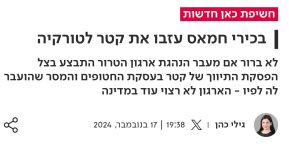
️️Hamas officials residing in Qatar have just left for Turkey.
- Joined
- Oct 16, 2016
- Status
- Not open for further replies.