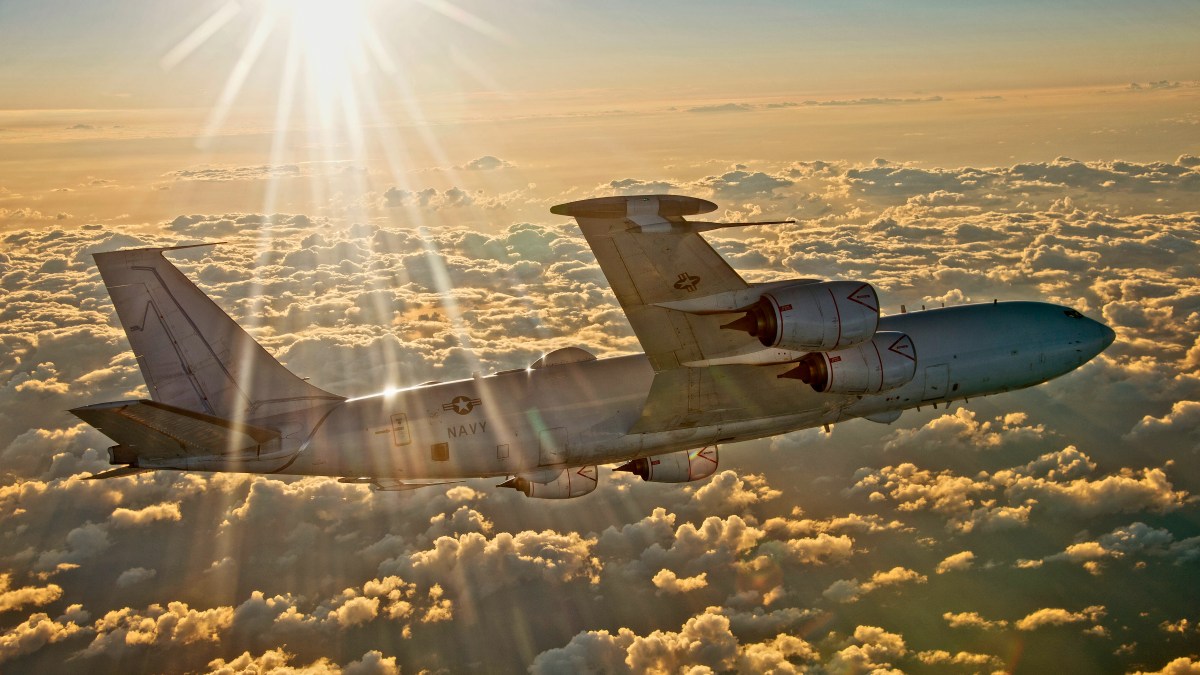
Yes — a TACAMO aircraft can be jammed, but its design and mission profile make it highly resistant to such interference.
TACAMO (Take Charge and Move Out) aircraft, such as the U.S. Navy’s Boeing E‑6B Mercury and the upcoming Lockheed Martin E‑130J Phoenix II, are specialized airborne command posts for relaying Emergency Action Messages (EAMs) to U.S. strategic nuclear forces, especially ballistic missile submarines
. They operate across a wide range of radio frequency bands, from very low frequency (VLF) up to super high frequency (SHF), using multiple modulations, encryptions, and networks
. This broad capability is intended to minimize the chance that a single jamming frequency or method will block all communications.
Why jamming is possible but difficult:
VLF and ELF bands: These are the most critical for submarine communication, as they penetrate seawater. However, VLF signals are extremely long-wavelength and low‑power, making them hard to jam effectively. They are also used in other military and civilian contexts, so jamming them can have unintended effects
Other bands: The aircraft also uses higher‑frequency satellite and HF links, which are more susceptible to jamming, but these are not the primary survivability path for nuclear command.
Redundancy: TACAMO is part of a layered command system. If one link is jammed, the aircraft can switch to another frequency or network, or the message can be relayed through other platforms
Physical and electronic hardening: The aircraft and its systems are hardened against electronic warfare, and crew training emphasizes maintaining communications under jamming conditions
In practice:
While a determined adversary could attempt to jam TACAMO’s higher‑frequency links, the VLF/ELF capability is so unique and critical that it is considered a “last resort” for nuclear command. The U.S. military’s design philosophy is to make jamming impractical rather than impossible — the goal is to ensure that even if some links are disrupted, the mission can continue through alternative means
Bottom line:
A TACAMO aircraft can be jammed, especially on certain frequency bands, but its multi‑band, encrypted, and redundant communications architecture, combined with its role as a strategic lifeline, makes successful jamming extremely difficult and operationally risky.
Current fleet (E-6B Mercury)
The Navy’s current TACAMO aircraft are the Boeing E-6B Mercury, operated by U.S. Strategic Command’s Strategic Communications Wing One (SCW‑1). SCW‑1 is based at Tinker Air Force Base, Oklahoma, and includes squadrons VQ‑3, VQ‑4, and VQ‑7
In addition to Tinker, there are alert bases at:
Travis Air Force Base, California (West Coast)
Naval Air Station Patuxent River, Maryland (East Coast)
Future fleet (E‑130J Phoenix II)
The Navy is replacing the E‑6B Mercury with the Northrop Grumman E‑130J Phoenix II, a modified C‑130J‑30 Super Hercules
. These aircraft will also be operated by SCW‑1 from Tinker AFB, Oklahoma, with squadrons VQ‑3, VQ‑4, and VQ‑7
The E‑130J will maintain the same global alert posture, with the same Tinker base as the current fleet, plus the existing Travis AFB and NAS Patuxent River alert sites
Summary of bases
Primary base: Tinker AFB, Oklahoma (SCW‑1 headquarters)
West Coast alert base: Travis AFB, California
East Coast alert base: NAS Patuxent River, Maryland