• Guests may view all public nodes. However, you must be registered to post.

UA-RU | Sep 18th-Mar 7th | Reports

  • Thread starter Thread starter NuclearID
  • Start date Start date
Status
Not open for further replies.
NATO eyes solar-powered high altitude platforms to counter GPS jamming:
NATO EDGE 2024 — NATO has been “looking at” overcoming Russian or Chinese GPS jamming by relaying satellite signals through ultra-high-flying aircraft, a NATO official told Breaking Defense.

“These are big, high-altitude planes that can stay for weeks in the air based on solar energy, and they can capture the GPS signal and send it down to earth with much more power that is more difficult to jam,” Brig. Gen. Sam Raeves, who serves as the assistant chief of staff of J6 Cyberspace at NATO, said in an interview on the sidelines of the NATO Edge conference here.

Extremely high-altitude platforms (HAPS), which can come in the form of balloons in addition to light-weight drones like the spindly Airbus-made Zephyr, are not yet in widespread use by NATO, Raeves said. But their potential for them to serve as GPS relays comes as officials have grown increasingly concerned about electronic warfare, a now-ubiquitous feature of the Russian-Ukrainian conflict.
When and if NATO does actually start implementing these types of HAPS, it could help improve the situational awareness issues that arise with GPS jamming, Raeves said.

“So this is what we try to do, to have combined situation awareness fusion,” he said. “This is really something that can solve it.”

In a separate interview, Artem Martynenko, the deputy head of the Center for Innovations and Defense Technologies at the Ukrainian Ministry of Defense, bemoaned the constant need to stay ahead of Russian forces in the EW realm.
Separately, a Ukrainian official told Breaking Defense that Kyiv's forces are constantly having to evolve their cyber and electronic warfare tactics to stay ahead of Russia.
 
Russian currency reserves at almost a third of prewar

Google translate:


Currency reserves of the Russian government have fallen to a minimum since 2008


The currency "cube", which the Russian government has been collecting for more than 10 years at the expense of raw material excess budget revenues, is approaching exhaustion.

The volume of liquid assets of the National Welfare Fund as of December 1 decreased to $53.8 billion, the Russian Ministry of Finance reported on Thursday. Since the beginning of the year, the free funds of the NWF, which was originally conceived as a mechanism for financing pensions, and then turned into a source of patching budget "holes", have decreased by another $2.1 billion.

Before the start of the war, the NWF had about $140 billion in liquid assets. Thus, in three years of hostilities, the "money cushion" of the Russian government has deflated almost three times.

If we exclude the gold that the fund holds in the form of impersonal metal accounts with the Central Bank, the size of its liquid assets has dropped to about $31 billion - the level with which the NWF was created in 2008, Bloomberg notes. We are talking about Chinese yuan - the last currency available to the Ministry of Finance: according to his data, as of December 1, the NWF held 219.5 billion yuan.

"Fiscal buffers (of the Russian government) are approaching exhaustion," says Alexander Isakov, an economist for the Russian Federation at Bloomberg Economics. According to him, this is a "key challenge" for Vladimir Putin, who continues to increase spending on the army and brought them to a record since Soviet times - 32.5% of the 2025 budget.

The authorities use the remnants of the yuan from the NWF to support the ruble, Isakov points out. In addition, the Chinese currency goes to the accounts of state corporations through the purchase of their bonds at the expense of the fund's money: in July, 3 billion yuan was spent for these purposes, in August - 2.75 billion, in September - 2 billion, in October - 1.25 billion, according to the Ministry of Finance.

Meanwhile, the NWF gold is gradually being sold to cover the budget deficit: from June to early December, 50 tons of precious metal were spent for these purposes, and its reserves in the NWF dropped to 279 tons.

In the budget for 2025, the government laid a deficit of 1.2 trillion rubles, in 2026 - 2.2 trillion, in 2027 - 2.8 trillion. In total, for three years, the "hole" in the treasury will amount to 6.2 trillion rubles, which is less than the free money left in the NWF - 5.8 trillion rubles, according to the estimates of the Ministry of Finance as of December 1.

As the "cup" is exhausted, it will be increasingly difficult for Putin to avoid the transition to a full-fledged "military economy", Isakov believes. Moscow is likely to "more and more redirect scarce labor and capital from sectors that are recognized as insignificant (services, construction and finance) to sectors that are considered critical in order to give Putin a military advantage," the expert warns.


Thank you Snowfall for finding and posting this gem! 👍👍
 
  • Like
Reactions: Bravo
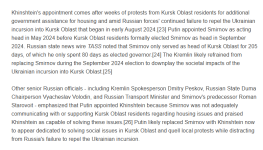
The Kremlin is scapegoating former Kursk Oblast Governor Alexei Smirnov for Russia's failure to adequately respond to Ukraine's incursion into Kursk Oblast. Russian President Vladimir Putin signed a decree on December 5 stating that Smirnov resigned "at his own request" and appointed Russian State Duma Information Policy Committee Head Alexander Khinshtein as acting Kursk Oblast governor.

Putin held a publicized meeting with Khinshtein on December 5 in which Putin offered Khinshtein the post of acting governor and emphasized the importance of crisis management in Kursk Oblast. Khinshtein's appointment comes after weeks of protests from Kursk Oblast residents for additional government assistance for housing and amid Russian forces' continued failure to repel the Ukrainian incursion into Kursk Oblast that began in early August 2024.

1000000637.png
 
There is no NATO without North America...

Trump calls for ‘immediate’ cease-fire in Ukraine, says U.S. withdrawal from NATO is possible​

Donald Trump on Sunday pushed Russian President Vladimir Putin to act to reach an immediate cease-fire with Ukraine, describing it as part of his active efforts as president-elect to end the war despite being weeks from taking office.

“Zelenskyy and Ukraine would like to make a deal and stop the madness,” Trump wrote on social media, referring to Ukraine’s president, Volodymyr Zelensky.

Trump also said he would be open to reducing military aid to Ukraine and pulling the United States out of NATO, in a television interview that aired Sunday.
 
SBU sea drones trained on Russian helicopters and planes: exclusive footage of the special operation "Sea Baby" in the Kerch Bay

Details of a new unique special operation of the Security Service have emerged. On the night of December 5-6, a group of SBU sea drones "Sea Baby" entered into battle with Russian helicopters, planes and patrol boats "Raptor", which tried to intercept them. These water drones were manufactured as a result of joint fundraising with UNITED24 (UNITED24), monobank (monobank), Oleg Gorokhovsky (ОГо!), Sergey Sternenko (STERNENKO) and Igor Lachen (Лачен пише) in February of this year.

The Russian pilots considered themselves hunters and counted on easy prey, but they became prey, because the sea drones opened fire in return.

The latest Sea Babys were equipped with large-caliber machine guns with ballistic programs for automatic guidance and auto-capture of targets.

Intercepted Russian radio transmissions indicate that there are killed and wounded on board the helicopters. The helicopters themselves were significantly damaged and now require major repairs.

SBU drones also hit a barge carrying military equipment and equipment for repairing the Crimean Bridge, which the occupiers are still unsuccessfully trying to restore after previous bombings by the Ukrainian special services.

Sea Baby is our multi-purpose platform, which can be used to carry various weapons: multiple launch rocket systems, flying drones, and large-caliber machine guns. "The main thing is that it has once again proven its effectiveness. The results of our work are actually much more than we can show now, but everything has its time," the 13th Main Directorate of the Military Counterintelligence Department of the SBU noted.


  • Like
Reactions: Torch

Ukraine’s Zelenskyy praises Trump as leader feared by Putin​

Ukrainian President Volodymyr Zelenskyy has praised Donald Trump as one of the only leaders feared by Russian President Vladimir Putin while calling on the international community to come together to end the war in Ukraine.
Speaking after meeting with Trump and French President Emmanuel Macron in Paris over the weekend, Zelenskyy said that the talks had been “very productive”, and he was grateful for Trump’s “strong resolve” to bring the conflict to an end.
 
  • Like
Reactions: Torch
Status
Not open for further replies.
Back
Top Bottom