Russian currency reserves at almost a third of prewar
Валютная «кубышка», которую правительство России более 10 лет собирало за счет сырьевых сверхдоходов бюджета, приближается к исчерпанию.

www.moscowtimes.ru
Google translate:
Currency reserves of the Russian government have fallen to a minimum since 2008
The currency "cube", which the Russian government has been collecting for more than 10 years at the expense of raw material excess budget revenues, is approaching exhaustion.
The volume of liquid assets of the National Welfare Fund as of December 1 decreased to $53.8 billion, the Russian Ministry of Finance reported on Thursday. Since the beginning of the year, the free funds of the NWF, which was originally conceived as a mechanism for financing pensions, and then turned into a source of patching budget "holes", have decreased by another $2.1 billion.
Before the start of the war, the NWF had about $140 billion in liquid assets. Thus, in three years of hostilities, the "money cushion" of the Russian government has deflated almost three times.
If we exclude the gold that the fund holds in the form of impersonal metal accounts with the Central Bank, the size of its liquid assets has dropped to about $31 billion - the level with which the NWF was created in 2008, Bloomberg notes. We are talking about Chinese yuan - the last currency available to the Ministry of Finance: according to his data, as of December 1, the NWF held 219.5 billion yuan.
"Fiscal buffers (of the Russian government) are approaching exhaustion," says Alexander Isakov, an economist for the Russian Federation at Bloomberg Economics. According to him, this is a "key challenge" for Vladimir Putin, who continues to increase spending on the army and brought them to a record since Soviet times - 32.5% of the 2025 budget.
The authorities use the remnants of the yuan from the NWF to support the ruble, Isakov points out. In addition, the Chinese currency goes to the accounts of state corporations through the purchase of their bonds at the expense of the fund's money: in July, 3 billion yuan was spent for these purposes, in August - 2.75 billion, in September - 2 billion, in October - 1.25 billion, according to the Ministry of Finance.
Meanwhile, the NWF gold is gradually being sold to cover the budget deficit: from June to early December, 50 tons of precious metal were spent for these purposes, and its reserves in the NWF dropped to 279 tons.
In the budget for 2025, the government laid a deficit of 1.2 trillion rubles, in 2026 - 2.2 trillion, in 2027 - 2.8 trillion. In total, for three years, the "hole" in the treasury will amount to 6.2 trillion rubles, which is less than the free money left in the NWF - 5.8 trillion rubles, according to the estimates of the Ministry of Finance as of December 1.
As the "cup" is exhausted, it will be increasingly difficult for Putin to avoid the transition to a full-fledged "military economy", Isakov believes. Moscow is likely to "more and more redirect scarce labor and capital from sectors that are recognized as insignificant (services, construction and finance) to sectors that are considered critical in order to give Putin a military advantage," the expert warns.
Thank you Snowfall for finding and posting this gem!





 breakingdefense.com


Tucker asks Russian Foreign Minister Sergey Lavrov what message Russia was sending with the revealing of their hypersonic weapons:
Ukrainian drone strikes reportedly hit the garrison of the Russian 3rd Motor Rifle Division (в/ч 54046) from the 20th Combined Arms Army in Boguchar, Voronezh Oblast of Russia, last night.
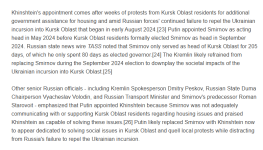
NEW - President Vladimir Putin has replaced the governor of the Kursk region -- partly controlled by Ukraine -- saying it needs a "crisis" manager, after residents voiced anger at the handling of the incursion.

 ️
 ️Pro-Russian elements within Moldova are now beginning to circulate fake videos of supposed "Romanian soldiers" calling their "brothers in arms" to "intervene" against the election annulment decision.


 www.latimes.com


